
Research has confirmed that trust is an essential element for establishing long-term relationships and successful negotiations across different cultures (Brett & Mitchell, 2020; Elahee et al., 2002; Kong et al., 2014; Kong & Yao, 2019, Liu et al., 2012). Trust is “crucial for business success” (Elo et al., 2015, p. 42), can lead to “more convenient commercial conditions” (Mandjak et al., 2019, p. 1217), and is especially important in negotiations, as outcomes are not immediate but “agreements represent explicit promises to engage in certain actions at some point in the future” (Mislin et al., 2011, p. 66).
Negotiation is a process of communication where at least two parties exchange information regarding interests, positions, and needs (Adair, 2003; Elahee & Brooks, 2004) and strive to resolve incompatible goals (Carnevale & Pruitt, 1992). Given the interdependence of the parties, where the achievement of their goals and outcomes is influenced by each other, trust becomes a critical factor (Pruitt, 1981; Kelley & Thibaut, 1978; Rusbult & Van Lange, 2003).
In recent decades, there has been a notable rise in international interactions involving individuals from diverse cultures (Brett & Okumura, 1998; Cheng et al., 2017; Gunia et al., 2016). In this review, culture is defined as national culture - a set of shared beliefs, values, norms, knowledge, and behaviors that define a particular group of people (Lytle et al., 1995; Mahadevan, 2017; Tylor, 1871). Intercultural negotiations present additional challenges compared to intracultural ones. People come together with different internalized norms, values, and attitudes (Gelfand et al., 2006), vary in ethicality (Volkema, 1998; Yang et al., 2017), favor different normative negotiation behaviors (Gunia et al., 2011; Liu et al., 2012; Luegger et al., 2015), and use diverse communication styles (Hall, 1976; Triandis et al. 1993). Consequently, culture influences both negotiation behavior (Adair et al., 2001; Brett & Okumura, 1998; Lituchy, 1997) and trust (Elahee & Brooks, 2004; Kee, 1969; Yao et al., 2021).
However, there is limited focus on the changes from intra- to intercultural contexts (Brett & Thompson, 2016; Gunia et al., 2016). To enhance our understanding of these complex interactions, it is essential to consider the dynamics that emerge when individuals adapt their behaviors and trust levels at the intercultural negotiation table, including the factors that facilitate such interactions (Adair et al., 2009; Pekerti & Thomas, 2003; Vasilyeva et al., 2023). To capture these in-group and out-group dynamics, we integrate three theories: Social Identity Theory (SIT) (Tajfel, 1974; Tajfel & Turner, 1979), Integrated Threat Theory of prejudice (ITT) (Stephan & Stephan, 1996, 2000), and Similarity-Attraction Theory (SAT) (Byrne, 1969). According to SIT, perceived differences with out-group members can lead to in-group favoritism (Tajfel & Turner, 1979), often driven by feelings of threat and intergroup anxiety as explained by ITT (Stephan & Stephan, 1996, 2000). These are common in intergroup interactions (Stephan et al., 1999) and typically hinder trust. However, perceived similarity can reduce these threats and anxieties, fostering trust (McAllister, 1995). SAT suggests that people are more likely to be attracted to others who share similar attitudes, beliefs, and values (Byrne, 1969). Therefore, successful intercultural adaptation may reduce intergroup anxiety and recategorize out-group members into an extended in-group, thereby building trust.
This literature review aims to provide a comprehensive yet concise overview of the current research landscape on trust in the context of intercultural negotiations. In response to Hodgkinson and Ford´s (2014) recommendation for enhanced rigor, this review employs a systematic approach. This results in a state-of-the-art review of 602 articles and an extensive analysis of 48 relevant papers. Our findings reveal that most research has been conducted in high-trust cultures, highlighting the need for further exploration in low-trust cultures like Latin America and the Middle East, especially by using qualitative research designs, to extend our understandings of trust dynamics in different cultures. Practitioners need to consider that building a trustful relationship in intercultural settings takes time and that cultures define relationships differently, focusing on either professional or personal relationships. This review provides several contributions: First, it organizes and synthesizes the literature through a systematic approach and a theoretical integration that has not been used in this context so far. Second, it underpins the importance of adaptation when negotiating with foreign cultures, as individuals adjust their trust levels and behaviors based on their counterpart´s culture, and appropriate adaptation may itself support the development of trust. Finally, it introduces a conceptual model which explains the trust mechanisms in intercultural negotiations.
This review is structured as follows. We begin by defining trust and providing the theoretical background, followed by the method section. Next, we present the findings, which include an examination of intercultural trust dynamics, the antecedents of trust, the trust building and trust repair processes, as well as the barriers to trust. The subsequent section discusses these findings, presents the Trust-Culture-Negotiation Model, and proposes future research avenues. We close the review with a conclusion.
Defining Trust
The literature presents various definitions of trust. Mandjak et al., (2019, p.1211) acknowledge that “trust is a highly complex phenomenon”. Johnson-George and Swap (1982, p. 1306) define it as “willingness to take risks”; and Mayer et al. (1995, p. 712) explain it in more detail as “the willingness of a party to be vulnerable to the actions of another party based on the expectation that the other will perform a particular action important to the trustor, irrespective of the ability to monitor or control that other party”. All these definitions refer to interpersonal trust or trust as a relational factor. Trust is dynamic, it can fluctuate, being formed at some times, and diminished at others (Wu & Laws, 2003).
Trust is inherently fragile, requiring consistent attention and effort to maintain. The necessary conditions for trust are risk and interdependence (Pruitt, 1981). Trust is required only when uncertainty exists, and one need to take a risk. The amount of trust indicates the extent of risk an individual is willing to take (Mayer et al., 1995). Interdependence exists when the interests of one party cannot be achieved without the other party (Rusbult & Van Lange, 2003). As these factors can vary over the course of an interaction or relationship, they can influence or alter both the form and level of trust (Rousseau et al., 1998). Thus, it is important to consider not only how a level of trust can change over time but also how changes or adaptations throughout interactions may lead to different trust levels.
While the meaning of trust is generally consistent across cultures, perceptions of trustworthiness can vary significantly based on cultural norms, values, and expectations (Gunia et al., 2011; Kong & Yao, 2019). When negotiators trust each other, they are confident that the other will not exploit their vulnerabilities. If we derive trustworthiness (Kong &Yao, 2019) or trusting beliefs (Kim et al., 2004) from this definition, a counterpart is considered trustworthy if they do not exploit the other´s vulnerabilities (Barney & Hansen, 1994). Mayer et al. (1995) summarize ability, benevolence, and integrity as three factors of trustworthiness. While other researchers have identified different factors like identification, humility, and closeness (Tan et al., 2007), the ABI-model (ability, benevolence, and integrity) is the most frequently cited. However, this tends to be Western culture-bound (Pruitt, 2004) and the degree of importance of each factor shifts across diverse cultural contexts (Kong & Yao, 2019), as well as other factors may arise in cultures beyond the West (Brett & Mitchell, 2020).
Trust is mainly measured by the perception of the other´s trustworthiness using several items with a Likert scale (Calantone et al., 1998; Elahee & Brooks, 2004; Gunia et al., 2011; Kim et al., 2004; Lee et al., 2006; Maddux et al., 2011; Mintu-Wimsatt et al., 2005; Yao et al., 2021; Yao & Storme, 2021; Zhang et al., 2015). These items include questions such as: “The other party will try to be someone who keeps promises and commitments” (Gunia et al., 2011, p.778), or “I would trust her/him as my negotiation counterpart” (Yao & Storme, 2021).
Generalized trust is the general tendency of the individual to trust others. This trust dimension refers to trust as a dispositional variable (Ross & LaCroix, 1996) or trust propensity (Kong & Yao, 2019; Mayer et al., 1995). Culture tends to significantly influence how individuals trust their counterparts (Elahee et al., 2002; Shapiro et al., 2008). In the next section, we will focus on the relevant theories, including the differentiation in low-trust and high-trust cultures.
Theoretical Background
Cultures can be classified based on various dimensions. The most frequently used cultural dimension in cross-cultural negotiation research is Hofstede´s collectivism vs. individualism (e.g. Adair et al., 2001; Brett & Okumura, 1998; Natlandsmyr & Rognes, 1995; Francis, 1991; Lituchy, 1997; Mintu-Wimsatt et al., 2005; Zhang et al., 2015). This describes the extent to which a society emphasizes the interdependence and cohesion of the group versus the independence and autonomy of the individual (Hofstede, 1980). Another relevant dimension is uncertainty avoidance. This defines how members of a culture feel threatened by unknown situations. High uncertainty avoidance cultures experience higher levels of anxiety and have a greater need of strict rules or regulations (Schumann et al., 2010). The GLOBE study introduced nine cultural dimensions (House et al., 2004). Yet, Aslani et al. (2016) have called for the use of a newer framework, as the use of traditional two-dimensional models leaves theoretical gaps. The dignity-face-honor framework (Leung & Cohen, 2011) is increasingly used in cross-cultural research. For instance, Aslani et al. (2016) demonstrated its usefulness for studying negotiation strategy. An adaptation by Pely & Shimoni (2019) refers to the framework as interest-face-honor.
Brett et al.´s (2017) theoretical framework combines levels of trust and cultural tightness-looseness. Trust propensity or the intension to trust differs among cultures (Brett et al., 2017). This can be distinguished in high-trust (Nations from the West and from East Asia) and low-trust cultures (Nations from South Asia, the Middle East, Latin America) (Brett & Mitchell, 2022; Fukuyama, 1995). High-trust nations are characterized by transparent governments, which protect people´s interests and reduce concerns about exploitation. This promotes a safer environment and lower uncertainty avoidance, encouraging trust in social interactions (Yao & Brett, 2021; Kong, 2013). Generally, high-trust is related to information sharing, Q&A (Questions & answers) and a cooperative behavior (Brett et al., 2017; Kong et al., 2014). Individuals from low-trust cultures tend to rely more on competitive behavior or S&O (Substantiation & offers) (Gunia et al., 2011). Low-trust individuals are predisposed to link certain behaviors to exploitation (Bazerman, 1994), although there is no clear evidence or “they will find such evidence and may ignore more significant disconfirming evidence” (Ross & LaCroix, 1996, p. 319). This is based on the low-trust cultural environment, where nations like Latin America suffer from corruption and apply low-trust in institutional systems (Brett & Mitchell, 2022). Especially relevant is also the cultural dimension on tightness-looseness (Gelfand et al., 2006). Social norms are less rigidly defined and enforced in loose as opposed to tight cultures. Thus, individuals from loose cultures (countries from the West and Latin America) tend to tolerate more likely deviations from social norms and expectations and rely on interpersonal trust based on their own judgements. In tight cultures (countries from East Asia, South Asia and the Middle East) where strict social norms are enforced, individuals tend to rely on situational norms (Gelfand et al., 2011; Yamagishi et al., 1998). As there are clearly defined norms where behavior is controlled and deviations are sanctioned (Gelfand et al., 2006), people from these cultures would expect others to follow the social norms and rules, would assume no risks, and would generally rely on institutional trust (Takahashi et al., 2008; Yamagishi & Yamagishi, 1994). It could be argued that an intracultural interaction would not entail significant risks and thus would not require interpersonal trust, as risk is a prerequisite for trust. However, negotiations, especially intercultural ones, lack clearly defined norms. Consequently, individuals from high-trust, tight cultures, similar to low-trust cultures, tend to reduce their trust levels from an intra- to an intercultural context. In these situations, they behave similarly to individuals from low-trust cultures, where interpersonal trust becomes relevant (Brett, 2007; Gunia et al., 2011).
When negotiating with people from different cultures, there is often an initial sense of disconnection, leading to uncertainty about behavior and a lack of trust (Debabi, 2010; Jungbok et al., 2004). Trust is particularly crucial in situations marked by risk or uncertainty (Kaufmann & Carter, 2006; Ribbink & Grimm, 2014). The complexity of the topic requires an integrated theoretical approach to provide a comprehensive understanding of trust mechanisms. Therefore, we integrate SIT, SAT and ITT to offer a multi-dimensional perspective, where identity, similarity, and threat perceptions interact in complex ways. This is also presented in Table 1.
Table 1 Integrated Theories and Their Connections: Social Identity, Threats, and Similarities

The Integrated Threat Theory of prejudice (Stephan & Stephan, 1996, 2000) emphasizes the detrimental effects of anxiety caused by perceived threats from an out-group, which can reinforce assumptions and prejudices (Stephan et al., 1999). ITT focuses on the emotional and cognitive processes associated with intergroup interactions. Intercultural negotiations are a form of intergroup contact that can create feelings of intergroup anxiety. These can arise due to negative stereotypes or prior negative experiences with out-group members, which may lead to negative behaviors or attitudes (Gudykunst & Nishida, 2001; Stephan et al., 1999), or uncertainty (Pekerti & Thomas, 2003), which hinder trust. Uncertainty is a relevant variable as it can predict intergroup bias and prejudice (Gudykunst & Shapiro, 1996). As Stephan (2014, p. 239) states “Intergroup anxiety helps us to understand why [intercultural interactions] are often more complicated and difficult than interactions with ingroup members.” People experiencing intergroup anxiety are less likely to trust others (Stephan, 2014). A lack of knowledge about the counterpart and their culture can lead to perceived threats. Thus, fostering personal interactions may help to reduce these threats and build trust.
According to Similarity-Attraction Theory (Byrne, 1969), perceived similarity leads to attraction and positive attitudes (Pornpitakpan, 1999) and can reduce threats and foster trust. Intercultural negotiations present additional challenges compared to intracultural ones due to differences in languages, behaviors, and norms (Francis, 1991). Adaptation is typically recommended to overcome these difficulties. The assumption is that bridging cultural distance through adaptation toward the counterpart may lead to perceived similarity (Pornpitakpan, 1999). This similarity can pertain to communication styles, values, attitudes, beliefs, or physical appearance. According to SAT (Byrne, 1969; Newcomb, 1978), individuals are viewed more favorably when they are perceived as similar. Apparent similarity may lead to improved outcomes and foster cooperation (Evans, 1963; McGuire, 1968; Rubin & Brown, 1975). Therefore, increasing perceived similarity - such as sharing common goals and values through intercultural adaptation - is recommended for building trust. Yet, some studies dispute the effects at substantial levels (Francis, 1991), as certain behaviors may be inappropriate for foreigners. While some form of adaptation is generally beneficial, substantial adaptation can be dysfunctional, as this could be interpreted as a manipulative attempt to gain favor (Jones & Wortman, 1973). This can be explained by Social Identity Theory (Tajfel, 1974; Tajfel & Turner, 1979), which posits that individuals categorize themselves and others into different groups. If individuals from distinct groups meet, as it is in intercultural negotiations, the interpersonal perspective needs to be extended by the intergroup perspective. Trust is generally higher within an in-group due to perceived shared identity. Consequently, a strong desire for distinctiveness can make substantial adaptation by out-group members a threat to their uniqueness (Brewer, 1999; Francis, 1991; Giles & Smith, 1979; Tajfel, 1978). As individuals seek to enhance or maintain positive self-esteem or reduce uncertainty, this can lead to in-group bias and potentially out-group derogation (Hinkle & Brown, 1990; Leach et al., 2008; Mullen et al., 1992). Particularly under conditions of uncertainty, group membership becomes more salient, and group´s norms provide guidance on appropriate behavior (Jetten et al., 2000). Collectivistic cultures and homogenous groups tend to make stronger in-group and out-group distinctions (Hinkle & Brown, 1990; Leach et al., 2008), which can lead to conflict or prejudice. Individuals from these cultures are often more competitive toward out-group members (Takahashi et al., 2008; Triandis, 1972; 1989). Viewing counterparts as out-group members creates a sense of threat, which in turn leads to more competitive behavior. In-group favoritism explains why similarity fosters trust. However, in-group love (attachment and positive feelings toward one´s in-group) does not automatically lead to out-group hate (hostility toward others outside in-group). Intergroup discrimination is often driven by preferential treatment of in-group members rather than hostility toward out-group members (Allport, 1954; Brewer, 1999, 2017). This aligns with Hamley et al. (2020), who suggest that in-group and outgroup warmth are not inversely related but are distinct constructs. As Brewer (p. 438, 1999) states, “Ultimately, many forms of discrimination and bias may develop not because outgroups are hated, but because positive emotions such as admiration, sympathy, and trust are reserved for the ingroup and withheld from outgroups.“ This implies that trust is withheld from out-group members because they are perceived as being outside the in-group. By recategorizing and reducing the boundary between “us” and “them”, trust-building becomes more achievable in intercultural negotiations. As Hitlin et al. (2021, p. 2) observe “people prioritize in-group members, even artificially created in-groups”.
In conclusion, an out-group that is too similar may, in turn, be perceived as a threat to group identity (Hewstone et al., 2002). Therefore, the key is to strike a balance between emphasizing shared values and maintaining distinctiveness. While sharing common goals and values can reduce conflict and foster trust, it is crucial that the in-group´s unique identity is still respected. Intercultural adaptation can mitigate the negative effects of in-group favoritism, facilitating the recategorization of out-group members into an extended in-group.
Method
This paper presents a systematic literature review of the current state of knowledge on trust in the context of intercultural negotiations. This section describes the steps taken to produce this review. To ensure a rigorous and transparent process, this review follows the systematic approach proposed by Denyer and Tranfield (2009), Rousseau et al. (2008), Thorpe et al. (2005), Tranfield et al. (2003). This is in alignment with recent reviews of negotiation literature (Caputo, 2013; Caputo et al., 2022; Cheng et al., 2017; Schoen, 2021a, 2021b). Thus, the review is built upon the three phases as outlined by Tranfield et al. (2003): planning and conducting the review, as well as reporting and dissemination.
The systematic accumulation of multiple studies with different designs but consistent findings can establish generalizability (Mulrow, 1994; Rousseau et al., 2008). Conducting a rigorous literature review in management and business research is of key importance, especially due to the increasing, fragmented, and diverse knowledge base (Denyer & Tranfield, 2009; Mulrow, 1994; Thorpe et al., 2005; Tranfield et al., 2003), including the application of different and competing research philosophies resulting in a variety of approaches toward the progress of knowledge in this research area (Azzopardi & Nash, 2014; Burrell & Morgan, 2019; Gill & Johnson, 2010; Rousseau et al., 2008). Denyer and Tranfield (2009) summarize four principles for conducting a systematic review, which are: Transparency, inclusivity, explanatory and heuristic.
Identification and Selection of Literature
This subsection explains the process used to produce the systematic review. The search strings were meticulously crafted through a series of systematic steps. The aim was to include all relevant literature on the topic as advocated by Thorpe et al. (2005). In the first stage, a “scoping search” was conducted. This phase involved analysing a selection of relevant articles on negotiations in a cross-cultural context including literature that focused on trust. The objective was to identify the keywords employed within these articles. In the next step, an investigation was undertaken to analyze keywords used in systematic reviews in the field of negotiations. For the first word group “negotiation”, the term “negotiation” is for instance searched in abstracts (Caputo, 2013, p. 381), the terms “negotiation” and “bargaining” in titles (Cheng et al., 2017, p. 300), the terms “negotiati*”, bargaining, conflict and agreement in titles and texts (Schoen, 2021b, p. 399), or the terms “negot*” and “bargain*”in titles and abstracts (Buelens et al., 2008, p. 326). Moreover, the terms negotiation and bargaining are proposed to be interchangeable (Rubin & Brown, 1975). For the initial search two levels of keywords were defined using Boolean Operators (AND and OR) and truncation. The first level included the terms cultur*, intercultural, inter-cultural, and cross-cultural. The second level included the terms negotiat* and bargain*. The search was carried out in Scopus including Article title, Abstract and Keywords, and in Web of Science (WoS) Core Collection via the TS (topic) command, including Title, Abstract, Author Keywords and Keywords Plus. Three criteria have been applied for inclusion, including journals, the English language, and relevant subject areas.
The search yielded 15,438 hits in Scopus and 4,863 in Web of Science. To ensure the relevance of articles on intercultural negotiations and on trust literature, a third level of terms considering trust and adaptation, using synonyms gathered from different thesauri, consisting of the terms adapt*, adjust*, alter*, differ*, change, chang*, intracultural, intra-cultural, and trust were added. The search resulted in 7,751 findings on Scopus and 2,522 on Web of Science. In continuation, a bibliometric analysis based on the co-occurrence of keywords was carried out to build a conceptual structure of the documents found. The outcome is a network of themes and their relations to one another. Relying on indexed keywords for such analysis can be heavily contingent on the effectiveness of indexers and their ability to capture all relevant terms (Zupic & Čater, 2015). As a result, author keywords were considered for this analysis. The software VOSViewer was used to create a map and to visualize the results of the bibliometric search in Scopus (van Eck & Waltman, 2010). Only keywords that appeared a minimum of 40 times were taken into consideration. This resulted in 40 keywords after excluding four terms related to specific countries. Figure 1 shows the visualization of the conceptual structure of the field and Table 2 shows the emerging clusters and keywords.
The search terms were adjusted due to the keyword analysis, leading to 949 documents from Scopus and 428 from Web of Science.
Table 2 Clusters and Keywords

Figure 1 Network Diagram and Visualization of Keywords

Subsequently, all journals that appeared more than once, were manually checked for their rankings in the academic journal guide (AJG 2021) published by the ABS. However, some relevant journals that were not included in the AJG 2021 were considered for the next stage as well. The combination of journal rankings and topical specialization is supported as appropriate for the inclusion and exclusion of articles (Cheng et al., 2017). In continuation, all articles focused on migration, immigration, acculturation, health, illness, coping, well-being, sexuality, and violence, were excluded using the Boolean Operator “AND NOT”. This resulted in 485 (Scopus) and 257 (Wos) findings. After merging duplicates the review sample for further processing resulted in 602 articles. These articles were reviewed based on abstracts and titles. During this step, 491 non-relevant articles were excluded, as they did not contribute to addressing the research aims. Subsequently, 111 articles were selected for full-text analysis. Following this, another 74 articles were excluded based on missing the relevance criteria. Backward and forward citation analysis led to the inclusion of 11 additional articles. The final review sample resulted in 48 articles. As recommended by Denyer and Tranfield (2009), Appendix A summarizes the path to the final review sample through a review protocol.
Data Analysis and Synthesis
Following Rousseau et al. (2008) this review integrates studies regardless of their methodological perspective, qualitative and quantitative data, critically reflecting the literature findings and synthesizing a comprehensive body of evidence. Including qualitative studies in a systematic review enriches the findings (Hodgkinson & Ford, 2014) and the aim is “to make a whole that should be more than the sum of the parts” (Denyer & Tranfield, 2009, p. 680). Appendix B reports the included studies.
The subsequent phase involved coding the articles and identifying themes emerging from their content. Inspired by Wolfswinkel et al. (2013) the process was dynamic: categories were identified and refined iteratively, moving back and forth and resulting in a fine-tuning of categories. Following this process, the structure emerged from the data.
Understanding and Navigating Trust in Intercultural Negotiations
In the context of intercultural negotiations, individuals from different cultures come together to interact and potentially build trustful relationships. While companies or organizations engage in business relationships, it is ultimately the individuals who interact and establish trust, as a company cannot trust (Weck & Ivanova, 2013). In addition to the interpersonal perspective, intercultural negotiations require an intergroup perspective. In intracultural contexts, similarity tends to foster trust (Byrne, 1969). In intercultural contexts, people from different countries often perceive themselves and others as members of distinct groups (Tajfel, 1970; 1974; Tajfel & Turner, 1979). This explains how individuals derive a sense of identity and self-esteem from their group memberships, which may lead to in-group bias and misleading assumptions about counterparts potentially resulting in perceived threats (Stephan & Stephan, 2000).
Building or repairing trust is challenging even in intracultural negotiations where individuals share cultural assumptions and values. This intensifies in intercultural negotiations, where individuals interact with differing communication styles, social norms and expectations (Adair, 2003; Adair et al., 2001; Liu et al., 2012; Kong & Yao, 2019). Misunderstandings, misbehavior, and emotions can have long-term implications that can affect the relationship and ultimately trust (Adair, 2003; Elo et al., 2015; Zhang et al., 2015).
Individuals tend to vary their behavior and trust levels when dealing with out-group members (intercultural negotiations) compared to in-group members (intracultural negotiations) (e,g, Adair et al., 2009; Elahee et al., 2002; Luegger et al., 2015). They often perceive out-group members as more likely to be untrustworthy or dishonest (Brewer, 1979). This perception aligns with ITT (Stephan & Stephan, 1996; 2000). Individuals have less information about members of out-groups, and thus face more uncertainty (Gelfand & Dyer, 2000; Turner, 1991), which can lead to incorrect assumptions or stereotypes. Adair et al. (2009) demonstrated that US and Japanese negotiators differentiate between intra- and intercultural contexts, basing their behavior not on their own intracultural assumptions but on the stereotypic knowledge or perceptions of the counterpart´s intracultural negotiation schema. Specifically, whether the counterpart is expected to be more competitive, or cooperative can influence adaptation. Consequently, the extent of joint gains, which is the value created in a negotiation (Brett et al., 2017), may be influenced by the nature of these assumptions and by the perceived negotiation type.
Negotiations with out-group members can also lead to suspicion (Lopez-Frenso et al., 2018). This is consistent with the cultural distance concept, which suggests that intercultural negotiations often involve uncertainty (Ha et al., 2004). The ability to adapt can reduce this uncertainty (Alteren & Tudoran, 2019; Peltokorpi 2008) and is therefore a crucial skill for building trust. Perceived similarity can lead to attraction and potentially to trust (Byrne, 1969; McAllister, 1995). Trust can result in better economic outcomes (Butler, 1999; Kong et al., 2014) and is central to successful negotiations (Lewicki & Polin, 2013), or as Druckman and Harinck (2022, p.1198) argue, “Trust may be the most important element in negotiations.”
Intercultural Trust Dynamics
Intercultural variation in trust exists (Balliet & Van Lange, 2013) and individuals from different cultures exhibit differences in their intensions to trust or their trust propensity (Kong, 2013; 2016). Empirical studies, such as those by Gunia et al. (2011), indicate lower trust levels in individuals from India compared to those from the US. Appendix C presents an overview of trust data from various waves of the World Values Survey (WVS), a global research project that provides data through surveys, including trust metrics. Western and East Asian countries are generally associated with high-trust, whereas countries from Latin America, Central and South Asia, the Middle East, and Africa are typically associated with low-trust. The ranking in Appendix C is sorted from low-trust to high-trust. To analyze the varying levels of trust toward different group members and within different cultural contexts, we used data from the question, “I´d like to ask you how much you trust people from various groups.” We defined “Your neighborhood” as in-group members and “people of another nationality” as out-group members. Figure 2 summarizes these trust levels with black columns and how the trust level reduces in an intercultural context in grey columns. The data shows that Western cultures do not significantly differentiate between in-group and out-group members. The counterparts are assumed to be trustworthy until they prove otherwise (Gunia et al., 2011). In contrast, other cultures show a marked difference in trust toward in-group and out-group members. Drawing on SIT, intercultural interactions can lead to in-group favoritism (Tajfel, 1970; Yang et al., 2017), and potentially to out-group derogation (Branscombe & Wann, 1994; Hewstone et al., 2002). Perceived threats to identity may result in distrust (Stephan & Stephan, 2000).
Collectivistic cultures and homogenous groups often make stronger in-group versus out-group distinctions (Hinkle & Brown, 1990; Leach et al., 2008). Consequently, all low-trust cultures, and even high-trust East Asian cultures, exhibit differences in trust levels. This may be because, considering the cultural dimension tightness-looseness, East Asia is a tight culture (Gelfand et al., 2006) and they generally rely on institutional trust. In intercultural negotiations where norms and rules are not clearly defined, the focus shifts to interpersonal trust (Gunia et al., 2011; Yamagishi & Yamagishi, 1994). Thus, uncertainty and perceived threat in intercultural interactions, as well as a lack of clearly defined norms, can lead to low trust levels, even in high-trust, tight cultures.
Figure 2 Trust Scores in %

Note. Data Source: World Values Survey Wave 4-7 (Haerpfer et al., 2022; Inglehart et al., 2014).
Consequently, whether individual trust can be derived from societal trust depends on the degree of face norms and whether information is processed holistically or analytically. A holistic approach considers the primary elements as well as their surrounding context (Nisbett et al., 2001). Yao and Brett (2021) demonstrate that societal trust can predict attitudinal trust and behavioral trust. However, in cultures with strong face norms (e.g. in East Asia, the Middle East, and South Asia), and holistic mindsets (especially in Latin America), this relationship is weaker.
People from the same culture share social norms and behavioral patterns (Patterson, 1983). In contrast, people from different cultures rely on distinguishing behavioral norms, which can lead to uncertainty due to unfamiliar norms and styles (Adair, 2003; Gudykunst, 1985). Consequently, intercultural interactions are often characterized by adaptation (Kim, 1988). Additionally, misunderstandings and conflicts may arise which can violate or reduce trust. Hall (1976) proposed the differentiation between high-context and low-context cultures, distinguishing an indirect style relying on implicit messages and indirect cues from a direct style relying on explicit communication (Hall, 1976). Explicit communication involves sharing priorities and interests, facilitating integrative agreements where both parties are satisfied. Communication styles are linked with cultural values, specifically collectivism with high-context and individualism with low-context (Pekerti & Thomas, 2003). Hall adds that these styles are further differentiated by their degree of communicative flexibility. High-context negotiators are assumed to be able to use direct and indirect communication and are more likely to adapt to their counterparts, while low-context negotiators primarily rely on direct communication (Adair, 2003; Hall, 1976). This is consistent with studies where Japanese negotiators adapted to their US American counterparts, while the latter did not adapt their behaviors (Adair, 2003; Adair et al., 2001). Indirect communication can also create tension for low-context negotiators (Lee et al., 2006). Therefore, direct integrative communication emerges as the pivotal juncture where behavioral patterns are most likely to match in an intercultural interaction (Adair, 2003). However, indirect communication via offers through heuristic trial and error search can also lead to integrative agreements or joint gains (Pruitt, 1981). This approach involves evaluating the evolution of offers over time, indicating negotiator´s flexibility on less valuable issues and their reluctance to compromise on more valuable ones (Adair et al., 2001; Adair, 2003; Pruitt, 1981). Different communication styles may lead to misinterpretations and challenges in effectively conveying messages and building rapport which is essential for trust building or trust repairing.
Elahee et al., 2002 and Elahee & Brooks, 2004 showed that individuals from Canada and the US do not significantly vary their trust levels or use of ethically questionable negotiation tactics between intra- and intercultural contexts. In contrast, Mexican individuals reduce their trust levels and increase the use of ethically questionable negotiation tactics in intercultural contexts. This aligns with the categorization of in-groups and out-groups as per SIT (Tajfel & Turner, 1979), and ITT (Stephan & Stephan, 2000), which suggests that perceived out-group threats may lead to lower trust and defensive behaviors. Consequently, the intercultural trust level may differ from that in intracultural settings, where SAT (Byrne, 1969) predicts that perceived similarity fosters trust. These differences must be considered when defining a negotiation strategy.
Antecedents and Consequences of Trust
Culture influences trust, affecting individuals´ intentions to trust across different cultural contexts. Empirical studies usually demonstrate lower joint gains in intercultural negotiations, (Adair et al., 2001; Brett & Okumura, 1998; Graham, 1985) which may arise due to a lack of skills to adapt successfully. This failure to disprove negative stereotyping and prejudice toward the counterpart and to establish a trustful relationship contributes to the reduced negotiation outcomes.
In their trailblazing study, Brett & Mitchell (2020, 2022) identified key actions that managers use when searching and deciding to place trust in various cultures. These include due diligence (search for information about the counterpart), brokerage (introduction to the counterpart by a third party), goodwill building (social interactions like small talk or a common dinner), and testing (asking and evaluating how the counterpart acts or reacts). The first two actions are done before a direct interaction with the potential counterpart occurs. The latter two actions occur in direct interactions and include the own judgement.
The trustworthiness of the counterpart is frequently evaluated using the dimensions ability, benevolence and integrity (Mayer et al., 1995). Acting cooperatively and adopting a problem-solving perspective can reassure the counterpart and alleviate concerns about exploitation (Deutsch, 1958; Lewicki et al., 1994). Trustworthiness of the other could be related according to Butler (1991) to consistency, availability, discreetness, competence, fairness, integrity, loyalty, openness, promise fulfillment, and receptivity. Brett and Mitchell (2020) suggest respect, mutual values, competence, openness, and professionalism as criteria for determining the trustworthiness of a business partner across different cultures. In low-trust, loose cultures, negotiators determine the trustworthiness by focusing on mutual values or similarities, which aligns with SAT (Byrne, 1969), as perceived similarity fosters trust. In low-trust, tight cultures, the focus is on respect for cultural differences, which can be understood through ITT (Stephan & Stephan, 1996, 2000), as managing perceived threats helps to build trust. High-trust, tight cultures, mainly prioritize the competence, which suggests that proving competence is a form of reducing threats. Meanwhile, in high-trust, loose cultures trustworthiness is often assumed, and the focus shifts to openness to information sharing during interactions (Brett & Mitchell, 2020), reflecting a low level of perceived threat and a general predisposition toward trust. These varying criteria for trustworthiness highlight the importance of adapting negotiation strategies across different cultural contexts.
The ability to adapt and communicate effectively is closely tied to one´s open-mindedness. This is an important personality trait enabling negotiators to understand counterpart´s priorities, respect diverse norms and values, and foster a sense of mutual understanding (Alteren & Tudoran, 2019). Cultural Intelligence (CQ) has been identified as a key factor in improving negotiation performance (Groves et al., 2015; Imai & Gelfand, 2010).
When a low-context party (from the West) shares information, they expect their counterpart to reciprocate, as Gouldner (1960) described. Refusing to reciprocate can hinder trust (Brett & Mitchell, 2020). However, if a high-context negotiator reciprocates indirectly, the low-context negotiator may not understand the other´s move (Brett & Okumura, 1998). This highlights the challenges of intercultural negotiations. Thus, experience with a counterpart from another culture can indicate their trustworthiness and predict future behavior (Styles et al., 2008).
Negotiation behavior is typically labelled integrative or distributive. The first is associated with Q&A (Questions & answers), assumed to create value and generate joint gains as priorities and interests are revealed, leading to win-win outcomes (Gunia et al., 2016; Kong et al., 2014; Oetzel & Ting-Toomey, 2003). and in turn develop trust (Yao et al., 2017). Lopez-Fresno et al. (2018, p. 13) conclude “they create a climate of trust that opens the door to future relationships.” This can be called the high-trust path to joint gains (Kong et al., 2014). Distributive strategies are labelled as S&O (substantiation & offers) strategies and assumed to claim value, leading to win-lose scenarios (Elahee & Brooks, 2004; Weingart et al., 1990, 2004). Integrative behavior can be direct and indirect. Multi-issue offers can be assumed as integrative (Gunia et al., 2014), single-issue offers rather represent distributive positioning (Adair, 2003). The basis for the application of an integrative strategy seems to be trust (Yamagishi, 1986). As the counterpart could take advantage of the shared information, a person must be willing to accept the risk before starting with questions and answers. Questions may be used as they could show what a negotiator doesn´t know. Answers reveal information about priorities which could contain sensitive information and could be exploited (Butler, 1999; Gunia et al., 2011; Kong et al., 2014). Low-trust elicits more likely a distributive strategy and high-trust more likely an integrative strategy. However, Brett et al. (2021) has shown that the assumption of a cooperative behavior through information sharing and joint gains is Western culture-bound. Additionally, distributive strategies do not necessarily mean less insight as Gunia et al.´s (2011) study showed. Caputo et al. (2019) even argue that individuals with high levels of collectivism tend to favour an integrative negotiation style. They would opt for a competitive negotiation style only when they score high on cultural intelligence.
According to Kee (1969), distrustful negotiators tend to make smaller offers, are more likely to use lies and threats, and make fewer attempts to exchange information. Studies indicate that trust may lead to a decrease in use of unethical negotiation behaviors (Elahee et al., 2002) and less deception (Dees & Cramton, 1991). Since deception can reduce joint gains and even break relationships, mutual trust could help prevent such behavior. This aligns with Zhang et al. (2015) who showed that cognition-based trust among Chinese negotiators reduce the use of deception, while affect-based trust might increase informational deception. This underscores the importance of building professional relationships in China or East Asian countries based on reliability and credibility. It can be distinguished between emotional and informational deception. Cultures differentiate in their use of emotions, which for instance was shown by Ramirez Marin et al. (2022) relating to anger and happiness and their consequences. They suggest that angry negotiators may secure greater concessions from their counterparts in intercultural negotiations. This is due to the higher uncertainty when interacting with foreigners; angry counterparts may evoke fear, leading to more concessions. Although this might result in favorable short-term outcomes, the long-term consequences on relationships and trust are likely negative. This also indicates the increased uncertainty in intercultural interactions, which depends on the counterpart´s culture. For instance, expressing anger is seen as culturally inappropriate in China (Adam et al., 2010), while it is socially acceptable in the United States. Additionally, informational deception is more acceptable in collectivistic cultures, where it is less likely to be detected due to the implicit communication style (Zhang et al., 2015).
Breaking trust causes more harm than good in the long-term, even if there seems to be immediate benefits at the moment of betrayal (Ross & LaCroix, 1996). This aligns with the use of ethically questionable negotiation tactics, which can cultivate distrust in the long run (Banai et al., 2014). Several studies explore the use of questionable negotiation tactics. Lewicki and Robinson (1998) summarize five: Bluffing, misrepresentation of position to an opponent, traditional competitive bargaining, attacking the opponent´s network, and inappropriate information gathering. When a negotiator detects unethical behavior, they tend to have lower trust toward their counterpart (Boles et al., 2000), and become more competitive (Kimmel et al., 1980). Conversely, higher trust levels may reduce the likelihood of unethical behavior (Elahee et al., 2002). However, Banai et al., 2014 did not find an overall relationship between trust propensity and ethically questionable negotiation tactics. This might be due to the participants being from low-trust cultures. Other studies suggest that Chinese negotiators are less likely to use these tactics interculturally (Yang et al., 2017). Elahee et al. (2002) and Elahee and Brooks (2004) found a negative relationship between trust and the use of ethically questionable negotiation tactics for Mexican individuals. This needs to be further studied.
Trust Building
Trust is a requirement for effective negotiations and mutually beneficial outcomes (Kong et al., 2014; Wu & Laws, 2003). At least some degree of trust seems to be necessary to enter an agreement (Ross & LaCroix, 1996), and it is most needed when there is a strong conflict of interests (Balliet & Van Lange, 2013). Naudé and Buttle (2000) emphasize that trust plays a significant role in determining relationship quality, noting that the duration of the relationship may also influence its quality.
Trust propensity determines the initial trust level before any interaction takes place. This varies across cultures (high-trust vs. low-trust) and can be influenced by external information, third party recommendations, assumptions, or previous experiences with individuals from the counterpart´s culture. This is followed by experienced trust that is generated between the parties during exchanges (Mandjak et al., 2019). Sharing common values can lead to trust. Thus, building a trustful relationship should be easier in an intracultural setting. This is often attributed to the presumption of greater cooperativeness in intracultural contexts, where compatible behaviors and values are common (Brett & Okumura, 1998), as reduced threats prevail in such settings (Stephan & Stephan, 2000), and similarity tends to promote trust (Adler & Graham, 1989; Byrne 1971). The general interaction with an out-group member and the opponent´s nationality can be relevant in determining trustworthiness in the pre-negotiation stage. Therefore, it is suggested that if individuals adapt, this could lead to shared values and similarities, thus fostering interpersonal attraction (Byrne, 1969; Newcomb, 1978). Value congruence could increase trust levels (Jones & George, 1998).
Trust building is different across cultures. Western cultures rely on quick trust (Alon & Brett, 2007) or the “swift trust” assumption: They trust a counterpart until the counterpart proves to be untrustworthy (Gunia et al., 2011). Additionally, individuals from Western cultures tend to prefer a quick small talk. This could be because individuals from Western cultures perceive fewer threats, resulting in less time spent on trust-building activities. In contrast, trust building in African cultures takes more time, as these cultures emphasize group harmony and value relationships (Sharma et al., 2020). Similarly, in the Arabic-speaking world and Latin America, negotiations typically do not begin until a certain level of trust has been established (Alon & Brett, 2007; Brett & Mitchell, 2020; Mandjak et al., 2019; Sobral et al., 2008). In these cultures, negotiations are seen as trust-building interactions (Alon & Brett, 2007), that require more time and effort to reduce perceived threats and foster common ground. They may be longer the higher the value of the transaction. Consequently, taking time is the price for building trust (Alon & Brett, 2007; Mandjak et al., 2019). It is also essential to acknowledge the different emphasis on relationships. While East Asia and the West focus on professional relationships, other regions focus on personal relationships (Brett & Mitchell, 2020; Mandjak et al., 2019), and “if one focuses too much on business and too little on the person” (Alon & Brett, 2007, p. 69), it could damage the relationship. As Alon and Brett (2007, p. 61) argue for negotiations in Arabic-speaking countries, “Engaging in conversation that follows these rules can be expected to strengthen the negotiation relationship.” Thus, adapting appropriately can help establish a trustful relationship. This includes respecting the differences in cultural norms, taking time for social interactions, sharing information, building understanding, or involving a third party for introductions (Brett & Mitchell, 2020; Gunia et al., 2014; Wu & Laws, 2003). Small talk or schmoozing can also enhance trustworthiness (Ramirez Marin et al., 2019), with more time spent on small talk correlating with higher trust (Mislin et al., 2011). Social interaction and open communication with the counterpart are crucial for trust building, as trust develops through a process of learning and experiencing to work with the counterpart (Blois, 1999).
Trust can be created or destroyed through cooperative or competitive moves (Ross & LaCroix, 1996). This indicates that adaptation is a relevant variable for building trust and that this can be influenced by the choice of negotiation behavior. The choice depends on the trust level involved (Mandjak et al., 2019) and the assumptions of the counterpart (Adair, 2009; Mintu-Wimsatt, 2005). A cooperative move, if reciprocated, leads to trust, otherwise it leads to a competitive move by the other party (Axelrod, 1984). Sharing information in Western cultures, is defined as a trustworthy behavior. If the counterpart does not reciprocate this is interpreted as an untrustworthy behavior (Gunia et al., 2011). When individuals adapt their negotiation behavior to align with a Q&A strategy, it is assumed to lead to the creation of joint gains (Ribbink & Grimm, 2014). Conversely, adapting to S&O strategies, like perceptions of zero-sum, tend to result in conflict and reduced joint gains (Adair, 2003; Gunia et al., 2016). Thus, culture and trust influence negotiation behavior (Brett et al., 2017; Elahee & Brooks, 2004; Elahee et al., 2002; Gunia et al., 2011; Kee, 1969; Luegger et al., 2015; Yao et al., 2021).
Studies also suggest that individuals may adapt their behavior in intercultural negotiations, not toward the other but by exaggerating their intracultural behavior. Interaction with an out-group member can create uncertainty (Pekerti & Thomas, 2003). This could be explained by a low initial trust level and by the focus on the distinctiveness between the groups (Tajfel, 1970; 1974; Tajfel & Turner, 1979). A moderate level of cultural adaptation should lead to successful outcomes (Francis, 1991) and successful trust development (Weck & Ivanova, 2013). Learning of the counterpart´s cultural values and norms is essential to build trust. Further interactions and learnings of the counterpart lead to an understanding of an appropriate level of adaptation, allowing the individuals to move from cautious interactions to a deeper trusting relationship (Weck & Ivanova, 2013). In their study, Lopez-Fresno et al. (2008) describe a scenario in which one party in an intercultural negotiation included a negotiator of Asian origin in an attempt to foster a climate of trust. Paradoxically, this action raised suspicions and distrust in the other party, likely due to differing expectations. In contrast, Pornpitakpan´s (1999) findings demonstrate that this curvilinear relationship is not confirmed for collectivistic or tight cultures like Thailand and Japan. This could be due to a higher focus on social harmony (Leung et al., 2011, Zhang et al., 2015), where substantial adaptation may be interpreted as a sign of respect (Pornpitakpan, 1999). However, while the findings showed that high levels of cultural adaptation did not decrease favorability, adaptation beyond a moderate degree did not increase it. Therefore, a moderate level of adaptation is generally recommended. Consequently, adaptation is a predominant factor in intercultural negotiations and should be considered in preparing the negotiation strategy during an interaction. In alignment with ITT and SAT, cultural adaptation can lead to reduced threats, increased attraction and trust. Yet, a substantial adaptation can lead to suspicion and can violate trust, as out-group members could be seen as threatening the in-group´s identity. In conclusion, moderate adaptation can lead to reduced uncertainty and intergroup anxiety and thus build a trustful relationship. Negotiators need to reduce uncertainty to diminish unfavorable adaptation by the counterpart and to build trust. Whereby, an appropriate level of adaptation may itself support the building of a trustful climate. This is dependent on personality traits and on several skills.
Developing a trustful relationship can be facilitated by a willingness to adapt which demonstrates a genuine interest in a long-term business relationship (Lohtia et al., 2009). Open-minded persons are better skilled in adapting (Alteren & Tudoran, 2019). Adaptive skills and cultural sensitivity can reduce other-anxiety in such interactions where uncertainty can prevail (Lohtia et al., 2009; Shapiro et al., 2008; Wu & Laws, 2003) and are in turn important to enhance communication with partners from other cultures, as trust often emerges as a result of successful communication (Nguyen & Nguyen, 2014). Communication should involve the clarification and the exchange of expectations (Adair et al., 2001). Other skills like intercultural competencies (Elo et al., 2015) and cultural intelligence (Groves et al., 2015) are also essential skills to build trust in intercultural negotiations. Cultural intelligence describes the ability to communicate effectively across cultures, self-awareness of one´s cultural biases, comprehension of cultural norms and values, and the flexibility to adapt in unfamiliar contexts. It also describes why some people are globally more effective than others (Ang et al., 2007). This includes the willingness and motivation to engage in new and potentially uncertain settings and facilitate intercultural negotiations (Groves et al., 2015; Imai & Gelfand, 2010; Liu et al., 2012).
Experienced negotiators may be more confident in negotiating with an out-group member and should feel less uncertainty (Adair et al., 2009; Gudykunst, 1995), thus, thinking beyond simple stereotypes (Fiske & Taylor, 1991). If the counterpart will be less experienced, than the experienced negotiator would be the one who should compensate and lead toward the reduction of counterpart´s uncertainty. This aligns with the interaction adaptation theory (Burgoon et al, 1995). This theory addresses the adaptation processes in interactions. Individuals enter those interactions with requirements, expectations, and desires (RED). If one´s RED are met, this will be positively reciprocated. However, if those are not met, one will diverge, to deescalate the situation (Burgoon et al., 1995). In contrast, if prejudices or negative assumptions do not prove true, this can lead to a more positive interaction and can lead toward a trustful relationship (Burgoon & Hubbard, 2005).
Additionally, biculturals are assumed to be better skilled at closing social distances between different cultures (Brannen & Thomas, 2010). In an intercultural study on negotiations with Korean and US participants, Kern et al (2012) showed that intercultural dyads achieved higher joint gains than intracultural dyads, presumably due to the bicultural parties (Kern et al., 2012).
Moreover, the choice of communication medium is important. Face-to-face negotiations can lead to higher trust than online negotiations, which often result in a decreased desire for future interactions. Face-to-face meetings are indispensable for trust building and repairing trust (Milgram, 1972; Lopez-Fresno et al., 2018; Naquin & Paulson, 2003). Caputo et al. (2023) found in their review on conflict in virtual teams that virtuality negatively affects trust levels, impacting conflict dynamics. This finding is also relevant for negotiation contexts. Therefore, negotiators should focus on meeting their counterparts in person, at least in the initial phase of the business relationship, to build trust.
Finally, while negotiators from high-relational cultures appreciate relational efforts, those from low-relational cultures are less concerned about the relationship (Lovett et al., 1999). A “relational negotiator” can strengthen relational capital, thereby increasing the level of trust in interactions with high-relational cultures (Cheng et al., 2017). Relational capital includes relational assets and mutual evaluation after the negotiation, encompassing mutual trust and fostering cooperation (Gelfand et al., 2006). This aligns with Yao & Storme (2021) who suggest that relationship satisfaction is necessary to build trust. A negotiator´s satisfaction with the relationship is particularly relevant for long-term trust building.
Trust Repair
Trust is a fragile construct and can be easily broken (Mandjak et al., 2019). Trust violation leads to reduced trust that may lead the trustee (the mistrusted party) to make efforts to repair trust. But how can trust be repaired? Research suggests that the process of trust repair may be more challenging than that of initial trust building (Kim et al., 2004), that trust recovery takes time (Lopez-Fresno et al., 2018), and several trust repair tactics are proposed, including apologies, denials, remedies, sincerity, reticence, or open and authentic as well as honest communication (e.g. Kim et al., 2004; Lopez-Fresno et al., 2018; Maddux et al., 2011).
Furthermore, the effectiveness of trust repair is subject to the type of violation and the culture, as forgiveness tends to differ across cultures (Kim et al., 2004). Similarly, how blame is assigned differs, as demonstrated in a study by Chiu et al. (2000). Following a news account reporting a pharmacist´s mix-up of medicines resulting in hundreds of patients falling ill, participants from China tended to attribute blame to the pharmacy, whereas Americans predominantly attributed blame to the individual pharmacist.
Apologies are a frequently mentioned trust repair mechanism. In contrast, to the meaning of trust that tends to be similarly understood amongst cultures, apologies differ in their meaning and function. Maddux et al. (2011) tested in a survey and experimental study the different interpretations between US-Americans and Japanese. While an apology in the US involves an admission of responsibility and an expression of regret, in Japan, it involves acknowledging the burden experienced by the recipient, emphasizing interconnectedness, and offering sympathy toward the counterpart. Apologies are more effective in cases of proven guilt or in case of competence-based violations, while denials are better suited for proven innocence or integrity-based violations (Kim et al., 2004). However, this may be differently perceived in other cultures, where other trustworthiness criteria are the focus and where apologies or denials could be interpreted differently. As suggested by Maddux et al. (2011) apologies are more effective in case of Americans for competence violations, and in case of Japanese for integrity violations. In their study, Japanese apologized more often and even in cases they were not responsible for the cause. This shows that to repair trust, tactics must be chosen carefully, especially when different cultures meet at the negotiation table with varying norms, to avoid escalating the conflict.
Consequently, as the willingness to trust is essential for building trust, the trustor´s (the violated party) willingness to accept repair efforts is crucial for successful trust repair (Kim et al., 2009). However, if the trustee unknowingly violates counterpart´s trust, they may not recognize it, and trust repair efforts may not follow (Kim et al., 2009). In intercultural settings, this can lead to increased perceived threat (ITT), which may heighten the distinction between in-group and outgroup members (SIT) and diminish the trust level. Trust violations stem from misunderstandings due to differing cultural values and norms (Kong & Yao, 2019). Trust repair may be easier if the violation was unconscious (Kim et al., 2009). We suggest that it is also essential to consider which criterion of trustworthiness has been violated. If we consider Brett & Mitchell´s (2020) trustworthiness criteria it would mean that if trust has been broken in areas such as respect, competence, values, openness, or professionalism, the trust repair measure should focus accordingly.
Barriers to Trust Development
In general, trust is the key to accepting vulnerability and to sharing information as the other is expected to be trustworthy and assumed not to exploit the shared information (Kong et al., 2014; Rousseau et al., 1998). However, if trust building seems not to be possible, Yao et al. (2021) suggest an alternative path to joint gains. Achieving high joint gains requires a general exchange of information. Although low-trust individuals, may not want to share direct information, they could use a multi-issue offer strategy (MIOs), which is an indirect style, that can lead to insights and joint gains, particularly when information is processed holistically (Yao et al., 2021). Consequently, by using this approach low-trust negotiators may also achieve joint gains. If the mindset is holistic rather than analytic, insights tend to be more accurate. They differ from S&O strategies, by incorporating multi-issue offers, which enable joint gains through concessions on low-priority issues while maintaining firm positions on high-priority issues (Brett et al., 2017; Yao et al., 2021). However, single-issue offers (SIOs) only focus on one issue at a time, and this could not reveal insights into the overall priorities and to trade-off potentials (Henderson et al., 2006). Therefore, MIOs can be successful for low-trust negotiators, as they can lead to insights and high joint gains (Yao et al., 2021). Alternatively, MIOs may lead to high joint gains without insights, but due to the concession mechanism or a trial-and-error process (Pruitt, 1981).
Chen et al. (2003) propose in their study self- and other concerns to be relevant for outcomes in negotiations. Egoistic negotiators with a high aspiration level will achieve higher individual profits only when the counterpart has prosocial motives. This relies on the dual concern model; win-win outcomes are only possible when integrative behavior is paired with a high resistance to yielding, a distributive behavior. This could indicate, that if trust is built, cooperative behavior may follow, and exploitation could be avoided, if there is a high resistance to yielding. The dual concern model is a framework that maps negotiation styles in a two-dimensional space of concerns (Pruitt & Rubin, 1986). Consequently, the dark side or second face of trust needs to be considered as well. As protections of being harmed are disarmed in trusting relationship, this could lead to exploitation and to betrayal. Warning signs of untrustworthiness that would be normally recognized, may not be heeded (McAllister, 1997). Trust may also cause biases and lead to suboptimal judgments and lower outcomes (Kong & Yao, 2019). A high level of affect-based trust increases the acceptance for informational deception (Zhang et al., 2015). Kong et al. (2014) showed in their meta-analysis, that integrative behavior was negatively related to trustor´s outcome but positively related to distributive behaviors. This implies that further research is needed that not only focus on joint gains but include individual gains and the second face of trust.
Discussion and Future Research Directions
We have reviewed existing literature on trust in the context of intercultural negotiations. The literature provides valuable insights; yet, the results show that there is still much to do in this research field. In this section, we begin by summarizing the key findings and continue by proposing a conceptual model that incorporates the relations of the main variables influencing trust, underpinned by findings and by theoretical integration. Finally, we explore future research opportunities.
Intercultural negotiations are challenging because individuals encounter different social norms, values and communication styles (Francis, 1991; Kong & Yao, 2019). The uncertainty in unfamiliar situations, unknown cultures, and interactions with foreigners causes individuals to adapt their trust levels and adjust their behaviors, as they tend to trust outgroup members less than their compatriots. Individuals categorize counterparts into in-groups and out-groups (Tajfel & Turner, 1979). Negative assumptions or stereotypes can lead to prejudices (Elahee et al., 2002; Stephan & Stephan, 2014) as explained by ITT (Stephan & Stephan, 1996, 2000). Intercultural adaptation that emphasizes shared values or goals can, in turn, reduce intergroup anxiety as per SAT.
Different languages and implicit communication styles can cause misunderstandings and conflicts, potentially breaking the business relationship (Brett & Okumura, 1998; Hall, 1976). Cultures vary in how they determine the trustworthiness of a counterpart. Generally, cultures are divided into high-trust (typically Western and East Asian countries) and low-trust (typically Latin American, South Asian and the Middle Eastern, Central Asian, and African countries) cultures. Considering tightness-looseness is necessary to explain trust differentiation between in-group and out-group members, as described in the conceptual model. Drawing on SIT and ITT, we suggest that shared values and similarities reduce uncertainty and perceived threats, thereby fostering trust between individuals. Therefore, appropriate adaptation is essential for building and repairing trust in intercultural negotiations. Personality traits and skills like cultural sensitivity, cultural intelligence and open-mindedness are crucial for success in intercultural interactions (Alteren & Tudoran, 2019; Groves et al., 2015; Imai & Gelfand, 2010). Finally, trust building takes time and patience, and negotiators should meet in person to establish relationships, especially with individuals from high-relational cultures. In contrast, low-relational cultures, typically Western countries, focus less on trust building and rely more on professional relationships. Research acknowledges the importance of trust in business relationships (Kong et al., 2014; Liu et al., 2012; McAllister, 1995); however, the second face of trust needs to be considered to exercise caution to avoid exploitation.
The Trust-Culture-Negotiation Model is illustrated in Figure 3. This model distinguishes between two key stages: the pre-negotiation stage, where individuals primarily evaluate counterparts´ trustworthiness based on assumptions and third-party information, and the negotiation stage, where individuals meet, communicate, and can make decisions based on direct interaction and personal observation. This aligns with the findings of Brett & Mitchell (2020; 2022) who demonstrated that individuals from different cultures undertake various actions when searching for information to evaluate a counterpart´s trustworthiness before the first meeting, and then make decisions on firsthand data during direct interactions. Other studies has shown that pre-assumptions and general trust play a significant role in the early stages of interactions (Adair et al., 2009; Gunia et al., 2011; Mandjak et al., 2019; Yao & Storme, 2021). Cultures vary in their trust propensity and can be categorized in high-trust and low-trust cultures. Individuals from low-trust cultures tend to assume their counterparts as untrustworthy until they build a relationship that allows to trust each other (Gunia et al., 2014; 2011).
Figure 3 The Trust-Culture-Negotiation Model.

Individuals from high-trust cultures give the counterpart the benefit of the doubt (Lewicki et al., 1996), a phenomenon known as ‘quick trust’ (Alon & Brett, 2007) or ‘swift trust’ (Gunia et al., 2011; Meyerson et al., 1996). This definition is only valid for Western countries. To explain the difference between Western and East Asian countries, both of which are high-trust cultures, we need to consider the cultural dimension tightness-looseness. This helps also to explain why East Asian countries vary their intension to trust depending on the cultural context. Tight cultures, characterized by clearly defined norms and a low tolerance for deviant behavior, often rely on institutional trust to guide interpersonal interactions (Gelfand et al., 2006). Since negotiations typically lack clearly defined norms, this issue becomes even more evident in intercultural settings. While high-trust, loose nations generally do not reduce their trust levels toward out-group members, high-trust, tight nations tend to adjust their trust levels compared to low-trust nations, as shown by the WVS data in Appendix C. This adjustment occurs because, in intercultural negotiations, individuals cannot expect their counterparts strictly to adhere to their social norms and expectations. Consequently, interpersonal trust becomes crucial, as individuals cannot rely on institutional trust (Brett, 2007; Gunia et al., 2011). Therefore, individuals from high-trust, tight cultures may place a greater importance on establishing a trustful relationship compared to those from high-trust, loose cultures. This is also because interactions with out-group members can create uncertainty (Pekerti & Thomas, 2003). While uncertainty exists in all relationships, it increases when people from different cultures meet (Gudykunst & Shapiro, 1996). Therefore, the model incorporates both Person A´s culture and Person B´s (the counterpart´s) culture, as the initial trust level varies not only based on Person A´s culture but also on the cultural context - specifically, whether the counterpart is perceived as a member of the in-group or out-group (Tajfel & Turner, 1979). Intercultural negotiations are typically characterized by a low-trust climate, at least at the beginning of interactions, until individuals get to know each other and reduce intergroup anxiety and prejudices (Stephan & Stephan, 1996, 2000). Intracultural negotiations tend to be marked by a higher-trust climate due to perceived similarity and reduced perceived threats.
Individuals bring their cultural values and norms into negotiations, as well as their expectations about the counterpart´s cultural assumptions and anticipated negotiation behaviors (Adair et al., 2009), and tend to adapt accordingly (Tinsley et al., 2002). Adair et al. (2009) suggest that assumptions that are made prior to the interactions are crucial. Thus, intercultural negotiations differ from intracultural ones, because of differences arising from assumptions, stereotyping and prejudices. Culture and the counterpart´s culture influence the trust level and affect the choice of negotiation behavior. If individuals develop stereotypes about the outgroup member that are negative, the interaction is anticipated to be unpleasant and the outgroup member is expected to be untrustworthy (Stephan et al., 1999). Consequently, limited knowledge about the outgroup member and their culture can heighten perceived threats, with individuals expecting dissimilarity (Stephan et al., 1999).
Personal interactions to get to know the other and potentially an adaptation toward the values and behavior of the counterpart, may reduce dissimilarity and perceived threats. If an individual assumes shared needs and goals with the counterpart, they act more cooperatively and adjust their attitude after perceiving similarity (Byrne, 1961; Evans, 1963; McGuire, 1968). According to SIT, individuals categorize themselves and others into groups, with differences becoming more salient in intercultural interactions, potentially leading to in-group bias. However, this bias does not result in out-group derogation, as in-group members are treated preferentially rather than with hostility toward out-group members (Allport, 1954; Brewer, 1999, 2017). As a result, trust is often reserved for the in-group, making it necessary to recategorize out-group members into an extended in-group through intercultural adaptation (Brewer, 1999; Hamley et al., 2020; Hitlin et al., 2021).
Various studies suggest that moderate adaptation is more successful than substantial adaptation. In the model, intercultural adaptation refers to efforts to alter communication styles, adjust differences in beliefs, and to modify negotiation behavior in order to reduce intergroup anxiety and increase perceived similarity. In line with this reasoning an appropriate adaptation can lead to the building of a trustful relationship.
One limitation of this review is the number of available studies. Although we used a systematic approach to prevent bias, our focus was primarily on published articles.
Most of the extant research relies on quantitative methodologies and is focused on Western and East Asian countries that represent high-trust cultures. Thus, research should extend to low-trust cultures to gain a fuller picture of the trust mechanisms. Additionally, the use of qualitative methodologies may be a potential for future research. As there is a lack of research on trust repair in an intercultural context, studying trust repair with the focus on low-trust cultures presents an intriguing avenue for future research.
Some studies do not explicitly consider a counterpart´s culture in their studies. As argued by Adair et al. (2009), negotiators think primarily intracultural and would not express their intercultural negotiation schemas when a salient cultural prime is absent. Therefore, further investigations are needed with an explicit consideration of counterpart´s culture. As it is suggested that uncertainty and prejudices can lead to the differentiation of trust levels between in-group and out-group members, it is crucial to consider if certain cultures tend to differ trust levels for specific regions and to consider adaptation as an important variable. Future research could also explore specific strategies for recategorizing out-group members into an extended in-group across diverse cultural contexts.
Furthermore, extant research focuses on two-party negotiations. However, in practice frequently teams are involved in negotiations. Dinkevych et al. (2017) is one of the studies which examined the adaptation processes, while a solo negotiator meets a team. Solo negotiators tend to adjust their negotiation style to that of the counterpart´s team. The asymmetric setting needs further empirical testing. There are also limitations in research on the link between cultural intelligence and negotiation performance. There are only few studies that have delved into this specific area (e.g. Caputo et al., 2019; Imai & Gelfand, 2010; Groves et al., 2015). Research should also focus on the long-term effects of trust building and trust repairing strategies.
Conclusion
In summary, this review highlights the critical role of trust in intercultural negotiations. Trust is essential for achieving mutually beneficial outcomes but is complicated by cultural differences. Consequently, negotiators need to understand and effectively manage these differences to enhance negotiation success. While trust building and establishing personal relationships are crucial in regions like Latin America, the Middle East, Africa, South and Central Asia, other regions focus more on professional relationships and task-oriented goals. Furthermore, it is essential to consider that most cultures tend to vary their trust level toward members of foreign cultures. Experience in different cultures and thorough preparation before intercultural negotiations can support successful interactions. Open-mindedness, cultural sensitivity, and cultural intelligence are important traits and skills that enable individuals to adapt appropriately in intercultural interactions. This emphasizes the importance of adaptive negotiation strategies in today's globalized business environment.
Author Note
The authors would like to thank the two anonymous reviewers and the editor for their insightful and helpful comments, which have greatly contributed to improving the paper.
References
Adair, W. L. (2003). Integrative sequences and negotiation outcome in same- and mixed-culture negotiations. International Journal of Conflict Management, 14(3-4), 273-296. https://doi.org/10.1108/eb022902
Adair, W. L., Okumura, T., & Brett, J. M. (2001). Negotiation behavior when cultures collide: The United States and Japan. Journal of Applied Psychology, 86(3), 371-385. https://doi.org/10.1037/0021-9010.86.3.371
Adair, W. L., Taylor, M. S., & Tinsley, C. H. (2009). Starting Out on the Right Foot: Negotiation Schemas When Cultures Collide. Negotiation & Conflict Management Research, 2(2), 138-163. https://doi.org/10.1111/j.1750-4716.2009.00034.x
Adam, H., Shirako, A., & Maddux, W. W. 2010. Cultural variance in the interpersonal effects of anger in negotiations. Psychological Science, 21(6): 882-889.
Adler, N. J., & Graham, J. L. (1989). Cross-Cultural Interaction: The International Comparison Fallacy? Journal of International Business Studies, 20(3), 515-537.
Allport, G. (1954). The nature of prejudice. Reading, MA: Addison- Wesley.
Alon, I., & Brett, J. M. (2007). Perceptions of time and their impact on negotiations in the Arabic-speaking Islamic world. Negotiation Journal, 23(1), 55-73. https://doi.org/10.1111/j.1571-9979.2007.00127.x
Alteren, G., & Tudoran, A. A. (2019). Open-mindedness and adaptive business style: Competences that contribute to building relationships in dissimilar export markets. International Marketing Review, 36(3), 365-390. https://doi.org/10.1108/IMR-08-2017-0142
Ang, S., Van Dyne, L., Koh, C., Ng, K. Y., Templer, K. J., Tay, C., & Chandrasekar, N. A. (2007). Cultural Intelligence: Its Measurement and Effects on Cultural Judgment and Decision Making, Cultural Adaptation and Task Performance. Management and Organization Review, 3(3), 335-371. https://doi.org/10.1111/j.1740-8784.2007.00082.x
Aslani, S., Ramirez-Marin, J., Brett, J., Yao, J., Semnani-Azad, Z., Zhang, Z.-X., Tinsley, C., Weingart, L., & Adair, W. (2016). Dignity, face, and honor cultures: A study of negotiation strategy and outcomes in three cultures. Journal of Organizational Behavior, 37(8), 1178-1201. https://doi.org/10.1002/job.2095
Axelrod, R. (1984). The evolution of cooperation. New York: Basic Book
Azzopardi, E., & Nash, R. (2014). An examination of philosophical paradigms and a rationale for adopting a mixed methods approach. Tourism Analysis, 19(2), 151-159. https://doi.org/10.3727/108354214X13963557455568
Balliet, D., & Van Lange, P. A. M. (2013). Trust, conflict, and cooperation: A meta-analysis. Psychological Bulletin, 139(5), 1090-1112. https://doi.org/10.1037/a0030939
Banai, M., Stefanidis, A., Shetach, A., & Özbek, M. F. (2014). Attitudes Toward Ethically Questionable Negotiation Tactics: A Two-Country Study. Journal of Business Ethics, 123(4), 669-685. https://doi.org/10.1007/s10551-013-2016-4
Barney, J. B., & Hansen, M. H. (1994). Trustworthiness as a Source of Competitive Advantage. Strategic Management Journal, 15, 175-190.
Bazerman, M. (1994). Judgment in managerial decision making (3rd ed.). New York: Wiley.
Blois, K.J. (1999), “Trust in business-to-business relationships: an evaluation of its status”, Journal of Management Studies, 36 (2), 197-217.
Boles, T. L., Croson, R., & Murnighan, J. K. (2000). Deception and retribution in repeated ultimatum bargaining. Organizational Behavior and Human Decision Processes, 83(2), 235-259.
Brannen, M. Y., & Thomas, D. C. (2010). Bicultural Individuals in Organizations: Implications and Opportunity. International Journal of Cross Cultural Management, 10(1), 5-16. https://doi.org/10.1177/1470595809359580
Branscombe, N.R. and Wann, D.L. (1994), “Collective self-esteem consequences of outgroup derogation when a valued social identity is on trial”, European Journal of Social Psychology, 24 (6), 641-657.
Brett, J. M. (2007). Negotiating globally: How to negotiate deals, resolve disputes, and make decisions across cultural boundaries (2nd ed.). San Francisco, CA: Jossey-Bass.
Brett, J. M., Gunia, B. C., & Teucher, B. M. (2017). Culture and negotiation strategy: A framework for future research. Academy of Management Perspectives, 31(4), 288-308. https://doi.org/10.5465/amp.2015.0195
Brett, J. M., & Mitchell, T. (2020). Searching for trustworthiness: Culture, trust and negotiating new business relationships. The International Journal of Conflict Management, 31(1), 17-39. https://doi.org/10.1108/IJCMA-05-2019-0085
Brett, J. M., & Mitchell, T. D. (2022). Searching for Trust in the Global Economy. University of Toronto Press. https://www.degruyter.com/document/doi/10.3138/9781487527969/html
Brett, J. M., & Okumura, T. (1998). Inter- and Intracultural Negotiation: U.S. and Japanese Negotiators. Academy of Management Journal, 41(5), 495-510. https://doi.org/10.5465/256938
Brett, J. M., Ramirez-Marin, J., & Galoni, C. (2021). Negotiation Strategy: A Cross-Cultural Meta-Analytic Evaluation of Theory and Measurement. Negotiation & Conflict Management Research, 14(4), 231-265.
Brett, J. M., & Thompson, L. (2016). Negotiation. Organizational Behavior and Human Decision Processes, 136, 68-79.
Brewer, M. B. (1979). In-group bias in the minimal intergroup situation: A cognitive-motivational analysis. Psychological Bulletin, 86(2), 307-324. https://doi.org/10.1037/0033-2909.86.2.307
Brewer, M. B. (1999). The Psychology of Prejudice: Ingroup Love and Outgroup
Hate? Journal of Social Issues, 55(3), 429-444. https://doi.org/10.1111/0022-4537.00126
Brewer, M. B. (2017). Intergroup discrimination: Ingroup love or outgroup hate? In C. G.
Sibley & F. K. Barlow (Eds.), The Cambridge handbook of the psychology of prejudice (pp. 90-110). Cambridge University Press.
Buelens, M., Van De Woestyne, M., Mestdagh, S., & Bouckenooghe, D. (2008). Methodological Issues in Negotiation Research: A State-of-the-Art-Review. Group Decision and Negotiation, 17(4), 321-345. https://doi.org/10.1007/s10726-007-9097-3
Burgoon, J. & Hubbard, A.S.E.. (2005). Cross-Cultural and Intercultural Applications of Expectancy Violations Theory and Interaction Adaptation Theory. In W.B. Gudykunst (Ed.), Theorizing about intercultural communication, 149-171.
Burgoon, J. K., Stern, L. A., & Dillman, L. (1995). Interpersonal adaptation: Dyadic interaction patterns. New York: Cambridge University Press.
Burrell, G., & Morgan, G. (2019). Sociological Paradigms and Organisational Analysis: Elements of the Sociology of Corporate Life (2nd ed.). Routledge. https://doi.org/10.4324/9781315609751
Butler, J. K. (1991). Toward understanding and measuring conditions of trust: Evolution of a Conditions of Trust inventory. Journal of Management, 17, 643-663.
Butler, J. K. (1999). Trust Expectations, Information Sharing, Climate of Trust, and Negotiation Effectiveness and Efficiency. Group & Organization Management, 24(2), 217-238. https://doi.org/10.1177/1059601199242005
Byrne, D. (1969). Attitudes and attraction. In L. Berkowitz, (Ed.), Advances in experimental social psychology, 4. New York: Academic Press.
Byrne, D. (1971). The attraction paradigm. New York, NY: Academic Press.
Calantone, R. J., Graham, J. L., & Mintu-Wimsatt, A. (1998). Problem-solving approach in an international context: Antecedents and outcome. International Journal of Research in Marketing, 15(1), 19-35. https://doi.org/10.1016/S0167-8116(97)00028-1
Caputo, A. (2013). A literature review of cognitive biases in negotiation processes. International Journal of Conflict Management, 24(4), 374-398. https://doi.org/10.1108/IJCMA-08-2012-0064
Caputo, A., Ayoko, O. B., Amoo, N., & Menke, C. (2019). The relationship between cultural values, cultural intelligence and negotiation styles. Journal of Business Research, 99, 23-36. https://doi.org/10.1016/j.jbusres.2019.02.011
Caputo, A., Kargina, M., & Pellegrini, M. M. (2022). Conflict in virtual teams: A bibliometric analysis, systematic review, and research agenda. International Journal of Conflict Management, 34(1), 1-31. https://doi.org/10.1108/IJCMA-07-2021-0117
Carnevale, P. J., & Pruitt, D. G. (1992). Negotiation and mediation. Annual Review of Psychology, 43(1), 531-582. https://doi.org/10.1146/annurev.ps.43.020192.002531
Chen, Y.-R., Mannix, E. A., & Okumura, T. (2003). The importance of who you meet: Effects of self- versus other-concerns among negotiators in the United States, the People’s Republic of China, and Japan. Journal of Experimental Social Psychology, 39(1), 1-15. https://doi.org/10.1016/S0022-1031(02)00514-0
Cheng, J., Huang, Y., & Su, Y. (2017). Relationality in negotiations: A systematic review and propositions for future research. International Journal of Conflict Management, 28(3), 295-321. https://doi.org/10.1108/IJCMA-12-2015-0091
Chiu, C., Morris, M. W., Menon, T., & Hong, Y. (2000). Motivated Cultural Cognition: The Impact of Implicit Cultural Theories on Dispositional Attribution Varies as a Function of Need for Closure. Journal of Personality and Social Psychology, 78(2), 247-259. https://doi.org/10.1037/0022-3514.78.2.247
Debabi, M. (2010). Contribution of cultural similarity to foreign products negotiation. Cross Cultural Management: An International Journal, 17(4), 427-437. https://doi.org/10.1108/13527601011086612
Dees, J. G., & Cramton, P. C. 1991. Shrewd bargaining on the moral frontier: Toward a theory of morality in practice. Business Ethics Quarterly, 1(2): 135-167.
Denyer, D., & Tranfield, D. (2009). Producing a systematic review. In The Sage handbook of organizational research methods (pp. 671-689). Sage Publications Ltd.
Deutsch, M. (1958). Trust and suspicion. Journal of Conflict Resolution, 2, 265-279.
Dinkevych, E., Wilken, R., Aykac, T., Jacob, F., & Prime, N. (2017). Can outnumbered negotiators succeed? The case of intercultural business negotiations. International Business Review, 26(3), 592-603.
Druckman, D., & Harinck, F. (2022). Trust Matters in Negotiation. Group Decision and Negotiation, 31(6), 1179-1202.
Elahee, M., & Brooks, C. M. (2004). Trust and negotiation tactics: Perceptions about business-to-business negotiations in Mexico. The Journal of Business & Industrial Marketing, 19(6), 397-404. https://doi.org/10.1108/08858620410556336
Elahee, M. N., Kirby, S. L., & Nasif, E. (2002). National culture, trust, and perceptions about ethical behavior in intra- and cross-cultural negotiations: An analysis of NAFTA countries. Thunderbird International Business Review, 44(6), 799-818. https://doi.org/10.1002/tie.10049
Elo, M., Benjowsky, C., & Nummela, N. (2015). Intercultural competences and interaction schemes—Four forces regulating dyadic encounters in international business. Industrial Marketing Management, 48, 38-49. https://doi.org/10.1016/j.indmarman.2015.03.007
Evans, F., B. 1963. Selling as a dyadic relationship-A new approach. American Behavioral Scientist, 6(May), 76-79.
Fiske, S. T., & Taylor, S. E. (1991). Social cognition. New York: McGraw-Hill, Inc.
Francis, J. N. P. (1991). When in Rome? The Effects of Cultural Adaptation on Intercultural Business Negotiations. Journal of International Business Studies, 22(3), 403-428. https://doi.org/10.1057/palgrave.jibs.8490308
Fukuyama, F. (1995), Trust: Social Virtues and the Creation of Prosperity, Hamish Hamilton, London.
Gelfand, M., & Dyer, N. (2000). A Cultural Perspective on Negotiation: Progress, Pitfalls, and Prospects. Applied Psychology, 49(1), 62-99. https://doi.org/10.1111/1464-0597.00006
Gelfand, M. J., Nishii, L. H., & Raver, J. L. (2006). On the nature and importance of cultural tightness-looseness. Journal of Applied Psychology, 91(6), 1225-1244.
Gelfand, M. J., Raver, J. L., Nishii, L., Leslie, L. M., Lun, J., Lim, B. C., Duan, L., Almaliach, A., Ang, S., Arnadottir, J., Aycan, Z., Boehnke, K., Boski, P., Cabecinhas, R., Chan, D., Chhokar, J., D’Amato, A., Ferrer, M., Fischlmayr, I. C., Yamaguchi, S. (2011). Differences Between Tight and Loose Cultures: A 33-Nation Study. Science (American Association for the Advancement of Science), 332(6033), 1100-1104. https://doi.org/10.1126/science.1197754
Giles, Howard & Philip Smith. 1979. Accommodation theory: Optimal levels of convergence. In Howard Giles & Robert N. St. Clair, (Eds.), Language and social psychology. Oxford: Basil Blackwell.
Gill, J., & Johnson, P. (2010). Research Methods for Managers | SAGE Publications Ltd. https://uk.sagepub.com/en-gb/eur/research-methods-for-managers/book232326
Gouldner, A. W. (1960). The norm of reciprocity: A preliminary statement. American Sociological Review, 25, 161-179.
Graham, J. L. (1985). The influence of culture on the process of business negotiations: An exploratory study. Journal of International Business Studies, 81-96.
Graham, J. L., & Herberger, R. A. (1983). Negotiators abroad—Don’t shoot from the hip. Harvard Business Review, 61(4), 160.
Graham, J. L., Mintu, A. T., & Rodgers, W. (1994). Explorations of Negotiation Behaviors in Ten Foreign Cultures Using a Model Developed in the United States. Management Science, 40(1), 72-95.
Groves, K. S., Feyerherm, A., & Gu, M. (2015). Examining Cultural Intelligence and Cross-Cultural Negotiation Effectiveness. Journal of Management Education, 39(2), 209-243. https://doi.org/10.1177/1052562914543273
Gudykunst, W. B. (1985). The influence of cultural similarity, type of relationship, and self-monitoring on uncertainty reduction processes. Communication Monographs, 52, 203-217.
Gudykunst, W. B. (1995). Anxiety/uncertainty management (AUM) theory: Current status. In R. L. Wiseman (Ed.), Intercultural communication theory (pp. 8-58.). Thousand Oaks, CA: Sage Publications.
Gudykunst, W. B., & Nishida, T. (2001). Anxiety, uncertainty, and perceived effectiveness of communication across relationships and cultures. International Journal of Intercultural Relations, 25(1), 55-71. https://doi.org/10.1016/S0147-1767(00)00042-0
Gudykunst, W. B., & Shapiro, R. (1996). Communication in everyday interpersonal and intergroup encounters. International Journal of Intercultural Relations, 20, 19-45.
Gunia, B., Brett, J., & Nandkeolyar, A. (2014). Trust me, I’m a negotiator: Diagnosing trust to negotiate effectively, globally. Organizational Dynamics, 43(1), 27-36. https://doi.org/10.1016/j.orgdyn.2013.10.004
Gunia, B. C., Brett, J. M., & Gelfand, M. J. (2016). The science of culture and negotiation. Current Opinion in Psychology, 8, 78-83. https://doi.org/10.1016/j.copsyc.2015.10.008
Gunia, B. C., Brett, J. M., Nandkeolyar, A. K., & Kamdar, D. (2011). Paying a Price: Culture, Trust, and Negotiation Consequences. Journal of Applied Psychology, 96(4), 774-789. https://doi.org/10.1037/a0021986
Ha, J., Karande, K. and Singhapakdi, A. (2004), “Importers’ relationships with exporters: does culture matter?”, International Marketing Review, 21 (4/5), 447-461.
Haerpfer, C., Inglehart, R., Moreno, A., Welzel, C., Kizilova, K., Diez-Medrano J., M. Lagos, P. Norris, E. Ponarin & B. Puranen (eds.). 2022. World Values Survey: Round Seven - Country-Pooled Datafile Version 5.0. Madrid, Spain & Vienna, Austria: JD Systems Institute & WVSA Secretariat. doi:10.14281/18241.20
Hall, E. T. (1976). Beyond culture (p. 256). Anchor.
Hamley, L., Houkamau, C. A., Osborne, D., Barlow, F. K., & Sibley, C. G. (2020). Ingroup
Love or Outgroup Hate (or Both)? Mapping Distinct Bias Profiles in the Population. Personality & Social Psychology Bulletin, 46(2), 171-188. https://doi.org/10.1177/0146167219845919
Henderson, M. D., Trope, Y., & Carnevale, P. J. (2006). Negotiation from a near and distant time perspective. Journal of Personality and Social Psychology, 91, 712-729.
Hewstone, M., Rubin, M., & Willis, H. (2002). Intergroup Bias. Annual Review of Psychology, 53(1), 575. https://doi.org/10.1146/annurev.psych.53.100901.135109
Hinkle, S., & Brown, R. J. (1990). Intergroup comparisons and social identity. In D. Abrams, & M. A. Hogg (Eds.), Social identity theory: Constructive and critical advances (48-70). New York: Springer Verlag.
Hitlin, S., Kwon, H. W., & Firat, R. (2021). In- and out-groups across cultures: Identities
and perceived group values. Social Science Research, 97, 102569-102569. https://doi.org/10.1016/j.ssresearch.2021.102569
Hofstede, G. (1980). Culture’s consequences. Beverly Hills, CA: Sage
Hodgkinson, G. P., & Ford, J. K. (2014). Narrative, meta-analytic, and systematic reviews: What are the differences and why do they matter? Journal of Organizational Behavior, 35(S1), S1-S5. https://doi.org/10.1002/job.1918
House R.J. et al. (2004): Culture, Leadership, and Organizations - The GLOBE Study of 62 Societies. Thousand Oaks: Sage Publications
Imai, L., & Gelfand, M. J. (2010). The culturally intelligent negotiator: The impact of cultural intelligence (CQ) on negotiation sequences and outcomes. Organizational Behavior and Human Decision Processes, 112(2), 83-98. https://doi.org/10.1016/j.obhdp.2010.02.001
Inglehart, R., C. Haerpfer, A. Moreno, C. Welzel, K. Kizilova, J. Diez-Medrano, M. Lagos, P. Norris, E. Ponarin & B. Puranen et al. (eds.). 2014. World Values Survey: Round Six - Country-Pooled Datafile Version: www.worldvaluessurvey.org/WVSDocumenta- tionWV6.jsp. Madrid: JD Systems Institute.
Jetten, J., Spears, R., Hogg, M. A., & Manstead, A. S. R. (2000). Discrimination constrained and justified: Variable effects of group vari- ability and ingroup identification. Journal of Experimental Social Psychology, 36, 329-356.
Johnson-George, C, & Swap, W. C. (1982). Measurement of specific interpersonal trust: Construction and validation of a scale to assess trust in a specific other. Journal of Personality and Social Psychology, 43,1306-1317.
Jones, G. R., & George, J. M. (1998). The Experience and Evolution of Trust: Implications for Cooperation and Teamwork. Academy of Management Review, 23(3), 531-546. https://doi.org/10.5465/AMR.1998.926625
Jones, E. E. & C. Wortman. 1973. Ingratiation: An attributional approach. Morristown, NJ: General Learning Press.
Jungbok, H., Karande, K. and Singhapakdi, A. (2004), ‘‘Importers of relationship with exporters: does culture matter?’’, International Marketing Review, London, 21 (4), 447.
Kaufmann, L., Carter, C.R., 2006. International supply relationships and non-financial
performance: a comparison of U. S. and German practices. Journal of Operations Management 24 (5), 653-675.
Kee, H. W. (1969). The development, and the effects upon bargaining, of trust and suspi- cion. Dissertation Abstracts International, 70, 4017A-4018A.
Kelley, H. H., & Stahelski, A. J. (1970). Social interaction basis of cooperators' and competitors' beliefs about others. Journal of personality and social psychology, 16(1), 66-91.
Kelley H.H., Thibaut J.W. (1978). Interpersonal Relations. New York: Wiley.
Kern, M. C., Lee, S., Aytug, Z. G., & Brett, J. M. (2012). Bridging social distance in inter-cultural negotiations: ‘you’ and the bi-cultural negotiator. International Journal of Conflict Management, 23(2), 173-191. https://doi.org/10.1108/10444061211218294
Kim, Y. Y. (1988). Communication and cross-cultural adaptation: An integrative theory. Clevedon, UK. Multilingual Matters.
Kim, P. H., Dirks, K. T., & Cooper, C. D. (2009). The Repair of Trust: A Dynamic Bilateral Perspective and Multilevel Conceptualization. Academy of Management Review, 34(3), 401-422. https://doi.org/10.5465/AMR.2009.40631887
Kim, P. H., Ferrin, D. L., Cooper, C. D., & Dirks, K. T. (2004). Removing the Shadow of Suspicion: The Effects of Apology Versus Denial for Repairing Competence- Versus Integrity-Based Trust Violations. Journal of Applied Psychology, 89(1), 104-118. https://doi.org/10.1037/0021-9010.89.1.104
Kimmel, M. J., Pruitt, D. G., Magenau, J. M., Konar-Goldband, E., & Carnevale, P. J. D. (1980). Effects of trust, aspiration, and gender on negotiation tactics. Journal of Personality and Social Psychology, 38(1), 9-22.
Kong, D. T. (2013). Examining a climatoeconomic contextualization of generalized social trust mediated by uncertainty avoidance. Journal of Cross-Cultural Psychology, 44, 574-588.
Kong, D. T., Dirks, K. T., & Ferrin, D. L. (2014). Interpersonal Trust Within Negotiations: Meta-Analytic Evidence, Critical Contingencies, and Directions for Future Research. Academy of Management Journal, 57(5), 1235-1255. https://doi.org/10.5465/amj.2012.0461
Kong, D. T., & Yao, J. (2019). Advancing the Scientific Understanding of Trust and Culture in Negotiations. Negotiation and Conflict Management Research, 12(2), 117-130. https://doi.org/10.1111/ncmr.12147
Leach, C., Van Zomeren, M., Zebel, S., Vliek, M., Pennekamp, S., Doosje, B., Ouwerkerk, J., & Spears, R. (2008). Group-Level Self-Definition and Self-Investment: A Hierarchical (Multicomponent) Model of In-Group Identification. Journal of Personality and Social Psychology, 95, 144-165. https://doi.org/10.1037/0022-3514.95.1.144
Lee, K., Yang, G., & Graham, J. L. (2006). Tension and Trust in International Business Negotiations: American Executives Negotiating with Chinese Executives. Journal of International Business Studies, 37(5), 623-641.
Leung, K., Brew, F. P., Zhang, Z. X., & Zhang, Y. 2011. Harmony and conflict: A cross-cultural investigation in China and Australia. Journal of Cross-Cultural Psychology, 42(5): 795- 816.
Leung, A. K.-Y., & Cohen, D. (2011). Within- and Between-Culture Variation: Individual Differences and the Cultural Logics of Honor, Face, and Dignity Cultures. Journal of Personality and Social Psychology, 100(3), 507-526. https://doi.org/10.1037/a0022151
Lewicki, R. J., Litterer, J. A., Minton, J. W., & Saunders, D. M. (1994). Negotiation (2nd ed.). Burr Ridge, IL: Irwin.
Lewicki, R. J., & Polin, B. (2013). Trust and negotiation. In Handbook of Research on Negotiation (pp. 161-190). Edward Elgar Publishing. https://www.elgaronline.com/display/edcoll/9781781005897/9781781005897.00016.xml
Lewicki, R. J., & Robinson, R. J. (1998). Ethical and Unethical Bargaining Tactics: An Empirical Study. Journal of Business Ethics, 17(6), 665-682.
Lewicki, R., Tomlinson, E., & Gillespie, N. (2006). Models of Interpersonal Trust Development: Theoretical Approaches, Empirical Evidence, and Future Directions. Journal of Management, 32. https://doi.org/10.1177/0149206306294405
Lituchy, T. R. (1997). Negotiations between Japanese and Americans: The Effects of Collectivism on Integrative Outcomes. Canadian Journal of Administrative Sciences, 14(4), 386-395. https://doi.org/10.1111/j.1936-4490.1997.tb00144.x
Liu, L. A., Friedman, R., Barry, B., Gelfand, M. J., & Zhang, Z.-X. (2012). The dynamics of consensus building in intracultural and intercultural negotiations. Administrative Science Quarterly, 57(2), 269-304. https://doi.org/10.1177/0001839212453456
Lohtia, R., Bello, D. C., & Porter, C. E. (2009). Building trust in US-Japanese business relationships: Mediating role of cultural sensitivity. Industrial Marketing Management, 38(3), 239-252.
Lopez-Fresno, P., Savolainen, T., & Miranda, S. (2018). Role of Trust in Integrative Negotiations. Electronic Journal of Knowledge Management: EJKM, 16(1), 13-22.
Lovett, S., Simmons, L.C. and Kali, R. (1999), “Guanxi versus the market: ethics and efficiency”, Journal of International Business Studies, 30 (2), 231-247.
Luegger, K., Geiger, I., Neun, H., & Backhaus, K. (2015). When East meets West at the bargaining table: Adaptation, behavior and outcomes in intra- and intercultural German-Chinese business negotiations. Journal of Business Economics, 85(1), 15-43. https://doi.org/10.1007/s11573-013-0703-3
Lytle, A. L., Brett, J. M., Barsness, Z. I., Tinsley, C. H., & Janssens, M. (1995). A paradigm for confirmatory cross-cultural research in organizational behavior. Research in Organizational Behavior, 17, 167-214.
Maddux, W. W., Kim, P. H., Okumura, T., & Brett, J. M. (2011). Cultural differences in the function and meaning of apologies. International Negotiation, 16(3), 405-425. https://doi.org/10.1163/157180611X592932
Mahadevan, J. (2017). A Very Short, Fairly Interesting and Reasonably Cheap Book About Cross-Cultural Management | SAGE Publications Ltd. Sage. https://uk.sagepub.com/en-gb/eur/a-very-short-fairly-interesting-and-reasonably-cheap-book-about-cross-cultural-management/book249455
Mandjak, T., Belaid, S., & Naude, P. (2019). The development of trust over time in an emerging market context: The case of the Tunisian automotive sector. Journal of Business & Industrial Marketing, 34(6), 1210-1222. https://doi.org/10.1108/JBIM-11-2017-0288
Mayer, R. C., Davis, J. H., & Schoorman, F. D. (1995). An Integrative Model of Organizational Trust. Academy of Management Review, 20(3), 709-734. https://doi.org/10.5465/AMR.1995.9508080335
McAllister, D. J. (1995). Affect- and cognition-based trust as foundations for interpersonal cooperation in organizations. Academy of Management Journal, 38, 24-59.
McAllister, D. J. (1997). The Second Face of Trust: Reflections on the Dark Side of Interpersonal Trust in Organizations. Research on Negotiation in Organizations, 6, 87-111.
McGuire, William J. 1968. The nature of attitudes and attitude change. In Lindzey Gardner & G. Aronson, editors, The handbook of social psychology. Reading.
Meyerson, D., Weick, K. E., & Kramer, R. M. (1996). Swift trust and temporary groups. In R. M. Kramer & T. R. Tyler (Eds.), Trust in organizations: Frontiers of theory and research (166-195). Thousand Oaks, CA: Sage.
Milgram, S. (1972). The Familiar Stranger: An Aspect of Urban Anonymity. In The Division, News letter, Division of Personality and Social Psychology. American Psychological Association.
Mintu-Wimsatt, A., Garci, R., & Calantone, R. (2005). Risk, trust and the problem solving approach: A cross cultural negotiation study. Journal of Marketing Theory and Practice, 13(1), 52-60. https://doi.org/10.1080/10696679.2005.11658538
Mislin, A. A., Campagna, R. L., & Bottom, W. P. (2011). After the deal: Talk, trust building and the implementation of negotiated agreements. Organizational Behavior and Human Decision Processes, 115(1), 55-68. https://doi.org/10.1016/j.obhdp.2011.01.002
Mullen, B., Brown, R., & Smith, C. (1992). Ingroup bias as a function of salience, relevance, and status: An integration. European Journal of Social Psychology, 22(2), 103-122.
Mulrow, C. D. (1994). Systematic Reviews: Rationale for systematic reviews. BMJ, 309(6954), 597-599. https://doi.org/10.1136/bmj.309.6954.597
Naquin, C. E., & Paulson, G. D. (2003). Online bargaining and interpersonal trust. Journal of Applied Psychology, 88(1), 113-120. https://doi.org/10.1037/0021-9010.88.1.113
Naudé, P., & Buttle, F. (2000). Assessing Relationship Quality. Industrial Marketing Management, 29(4), 351-361. https://doi.org/10.1016/S0019-8501(00)00112-7
Natlandsmyr, H. J., & Rognes, J. (1995). Culture, Behavior, and Negotiation Outcomes: A Comparative and Cross-Cultural Study of Mexican and Norwegian Negotiators. International Journal of Conflict Management, 6(1), 5-29. https://doi.org/10.1108/eb022753
Newcomb, T., M. 1978. Interpersonal balance. In Robert P. Abelson, E. Aronson, W.J. Mcquire, T.M. Newcomb, M.J. Roseberg & R.H. Tannenbaum, editors, Theories of cognitive consistency: A sourcebook. Chicago, IL: Rand McNally.
Nguyen, T.T.M. and Nguyen, T.D. (2014), The impact of cultural sensitivity and information exchange on relationship quality, Marketing Intelligence & Planning, 32 (7), 754-768.
Nisbett, R.E., Peng, K., Choi, I. and Norenzayan, A. (2001), Culture and systems of thought: holistic versus analytic cognition, Psychological Review, 108 (2), 291-310.
Oetzel, J. G., & Ting-Toomey, S. (2003). Face concerns in interpersonal conflict: A cross-cultural empirical test of the face negotiation theory. Communication Research, 30(6), 599-624. https://doi.org/10.1177/0093650203257841
Patterson, M. L. (1983). Nonverbal behavior: A functional perspective. New York: Springer-Verlag.
Pekerti, A., & Thomas, D. (2003). Communication in intercultural interaction—An empirical investigation of idiocentric and sociocentric communication styles. Journal of Cross-cultural Psychology, 34(2), 139-154. https://doi.org/10.1177/0022022102250724
Peltokorpi, V. and Froese, F.J. (2012), “The impact of expatriate personality traits on cross-cultural adjustment: a study with expatriates in Japan”, International Business Review, 21 (4), 734-746.
Pely, D., & Shimoni, D. (2019). The Culture of Interest: A Proposed Addition and Revision of the Three-Culture Model. Negotiation Journal, 35 (2), 247-268.
Petticrew, M., & Roberts, H. (2005). Systematic Reviews in the Social Sciences: A Practical Guide. John Wiley & Sons, Incorporated. http://ebookcentral.proquest.com/lib/shu/detail.action?docID=239885
Pornpitakpan, C. (1999). The Effects of Cultural Adaptation on Business Relationships: Americans Selling to Japanese and Thais. Journal of International Business Studies, 30(2), 317-337.
Pruitt, D. (1981). Negotiation Behavior. New York, NY: Academic Press.
Pruitt, D. (2004), “Forward”, in Gelfand, M.J. and Brett, J.M. (Eds), Handbook of Negotiation and Culture: Theoretical Advances and Cultural Perspectives, Stanford University Press, Palo Alto, CA.
Pruitt D. G., & Rubin, J. Z. (1986). Social conflict: Escalation, stalemate, and settlement. Random House.
Ramirez Marin, J., Olekalns, M., & Adair, W. (2019). Normatively Speaking: Do Cultural Norms Influence Negotiation, Conflict Management, and Communication? In Negotiation and Conflict Management Research, 12 (2), 146-160. Wiley Subscription Services, Inc. https://doi.org/10.1111/ncmr.12155
Ramirez-Marin, J. Y., Barragan Diaz, A., & Guzman, F. A. (2022). When anger and happiness generate concessions: Investigating counterpart’s culture and negotiation intentions. The International Journal of Conflict Management, 33(1), 111-131. https://doi.org/10.1108/IJCMA-03-2021-0047
Ribbink, D., & Grimm, C. M. (2014). The impact of cultural differences on buyer-supplier negotiations: An experimental study. Journal of Operations Management, 32(3), 114-126. https://doi.org/10.1016/j.jom.2014.01.004
Ross, W., & LaCroix, J. (1996). Multiple Meanings of Trust in Negotiation Theory and Research: A Literature Review and Integrative Model. The International Journal of Conflict Management, 7(4), 314-360. https://doi.org/10.1108/eb022786
Rousseau, D., Manning, J., & Denyer, D. (2008). 11 Evidence in Management and Organizational Science: Assembling the Field’s Full Weight of Scientific Knowledge Through Syntheses. Academy of Management Annals, 2, 475-515. https://doi.org/10.5465/19416520802211651
Rousseau, D. M., Sitkin, S. B., Burt, R. S., & Camerer, C. (1998). Not so different after all: A cross-discipline view of trust. Academy of Management Review, 23(3), 393-404.
Rubin, J. Z., & Brown, B. R. (1975). The Social Psychology of Bargaining and Negotiation. Elsevier.
Rusbult, C. E., & Van Lange, P. A. M. (2003). Interdependence, Interaction, and Relationships. Annual Review of Psychology, 54(1), 351. https://doi.org/10.1146/annurev.psych.54.101601.145059
Schoen, R. (2021a). Getting to Yes in the cross-cultural-context: ‘One size doesn’t fit all’ - a critical review of principled negotiations across borders. International Journal of Conflict Management, 33(1), 22-46. https://doi.org/10.1108/IJCMA-12-2020-0216
Schoen, R. (2021b). Lacking pluralism? A critical review of the use of cultural dimensions in negotiation research. Management Review Quarterly, 71(2), 393-432. https://doi.org/10.1007/s11301-020-00187-5
Schumann, J. H., Wangenheim, F. v, Stringfellow, A., Zhilin Yang, Praxmarer, S., Jiménez, F. R., Blazevic, V., Shannon, R. M., G., S., & Komor, M. (2010). Drivers of Trust in Relational Service Exchange: Understanding the Importance of Cross-Cultural Differences. Journal of Service Research: JSR, 13(4), 453-468.
Shapiro, J. M., Ozanne, J. L., & Saatcioglu, B. (2008). An Interpretive Examination of the Development of Cultural Sensitivity in International Business. Journal of International Business Studies, 39(1), 71-87.
Sharma, S., Elfenbein, H. A., Sinha, R., & Bottom, W. P. (2020). The Effects of Emotional Expressions in Negotiation: A Meta-Analysis and Future Directions for Research. Human Performance, 33(4), 331-353. https://doi.org/10.1080/08959285.2020.1783667
Sobral, F., Carvalhal, E., & Almeida, F. (2008). The Influence of Culture on Negotiati on Styles of Brazilian Executives. Management Research: Journal of the Iberoamerican Academy of Management, 6(2), 107-119. https://doi.org/10.2753/JMR1536-5433060203
Stephan, W. G. (2014). Intergroup Anxiety: Theory, Research, and Practice. Personality and Social Psychology Review, 18(3), 239-255.
Stephan, W., & Stephan, C. (1996). Predicting prejudice: The role of threat. International Journal of Intercultural Relations, 20, 409-426.
Stephan, W. G.; Stephan, C. W. (2000). An integrated threat theory of prejudice. In Oskamp, S. (Ed.) Reducing Prejudice and Discrimination (23-45). Mahwah, N.J.: Lawrence Erlbaum Associates.
Stephan, W. G., Stephan, C. W., & Gudykunst, W. B. (1999). Anxiety in intergroup relations: A comparison of anxiety/uncertainty management theory and integrated threat theory. International Journal of Intercultural Relations, 23(4), 613-628.
Styles, C., Patterson, P. G., & Ahmed, F. (2008). A relational model of export performance. Journal of International Business Studies, 39(5), 880-900. https://doi.org/10.1057/palgrave.jibs.8400385
Tajfel, H. (1970). Aspects of national and ethnic loyalty. Social Science Information, 9(3), 119-144. https://doi.org/10.1177/053901847000900305
Tajfel, H. (1974). Social identity and intergroup behavior. Social Science Information, 13, 65-93.
Tajfel, H. (1978). Social categorization, social identity, and social com- parison. In Henri Tajfel, (Ed.), Differentiation between social groups: Studies in the social psychology of intergroup relations. London: Academic Press.
Tajfel, H. (1982). Social psychology of intergroup relations. Annual Review of Psychology, 33, 1-39. https://doi.org/10.1146/annurev.ps.33.020182.000245
Tajfel, H. & Turner, J. C. (1979). An integrative theory of intergroup conflict. In W.G. Austin & S. Worchels, editors, The social psychology of intergroup relations. Monterey, CA: Brooks/Cole.
Takahashi, C., Yamagishi, T., Liu, J. H., Wang, F. X., Lin, Y. C., & Yu, S. (2008). The intercultural trust paradigm: Studying joint cultural interaction and social exchange in real time over the Internet. International Journal of Intercultural Relations, 32, 215-228.
Tan, H. H., Wasti, S. A., & Eser, S. (2007). Location, location, location: Antecedents of trust across hierarchical and geographical positions. Paper presented at the Twenty-Third European Group for Organizational Studies Colloquium, Vienna, Austria
Thorpe, R., Holt, R., Macpherson, A., & Pittaway, L. (2005). Using knowledge within small and medium-sized firms: A systematic review of the evidence. International Journal of Management Reviews: IJMR, 7(4), 257-281.
Tinsley, C. H., O’Connor, K. M., & Sullivan, B. A. (2002). Tough guys finish last: The perils of a distributive reputation. Organizational Behavior and Human Decision Processes, 88, 621-642.
Tranfield, D., Denyer, D., & Smart, P. (2003). Towards a Methodology for Developing Evidence-Informed Management Knowledge by Means of Systematic Review. British Journal of Management, 14(3), 207-222. https://doi.org/10.1111/1467-8551.00375
Triandis, H. C. (1972). The analysis of subjective culture. NewYork: Wiley.
Triandis, H. C. (1989). The self and social behavior in differing cultural contexts. Psychological Review, 96(3), 506-520.
Triandis, H. C., McCusker, C., Betancourt, H., Iwao, S., Leung, K., Salazar, M. J., et al. (1993). An etic-emic analysis of individualism and collectivism. Journal of Cross-Cultural Psychology, 24, 366-383
Turner, J. C. (1991). Social influence. Thomson Brooks/Cole Publishing Co.
Tylor, E. B. (1871). Primitive Culure: Reseachers into the Development of Mythology. London: John Murray.
van Eck, N. J. P., & Waltman, L. R. (2010). Software survey: VOSviewer, a computer program for bibliometric mapping. Scientometrics, 84(2), 523-538. https://doi.org/10.1007/s11192-009-0146-3
Vasilyeva, E., Bultseva, M., & Lebedeva, N. (2023). Face Concerns in Intra- and Intercultural Business Communication. Journal of Intercultural Communication Research, 52(3), 237-260. https://doi.org/10.1080/17475759.2022.2161602
Volkema, R. J. (1998). A comparison of perceptions of ethical negotiation behavior in Mexico and the United States. International Journal of Conflict Management, 9(3), 218-233.
Weck, M., & Ivanova, M. (2013). The importance of cultural adaptation for the trust development within business relationships. The Journal of Business & Industrial Marketing, 28(3), 210-220. https://doi.org/10.1108/08858621311302868
Weingart, L. R., Olekalns, M., & Smith, P. L. (2004). Quantitative Coding of Negotiation Behavior. International Negotiation, 9(3), 441-455. https://doi.org/10.1163/1571806053498805
Weingart, L. R., Thompson, L. L., Bazerman, M. H., & Carroll, J. S. (1990). Tactical Behavior and Negotiation Outcomes. International Journal of Conflict Management, 1(1), 7-31. https://doi.org/10.1108/eb022670
Wolfswinkel, J. F., Furtmueller, E., & Wilderom, C. P. M. (2013). Using grounded theory as a method for rigorously reviewing literature. European Journal of Information Systems, 22(1), 45-55. https://doi.org/10.1057/ejis.2011.51
Wu, J., & Laws, D. (2003). Trust and Other-Anxiety in Negotiations: Dynamics Across Boundaries of Self and Culture. Negotiation Journal, 19(4), 329-367. https://doi.org/10.1023/A:1026094821330
Yamagishi, T. (1986). The provision of a sanctioning system as a public good. Journal of Personality and Social Psychology, 56, 110-116.
Yamagishi, T., Cook, K. S., & Watabe, M. (1998). Uncertainty, trust, and commitment formation in the United States and Japan. American Journal of Sociology, 104, 165-194. doi:10.1086/210005
Yamagishi, T., & Yamagishi, M. (1994). Trust and commitment in the United States and Japan. Motivation and Emotion, 18, 129-166. doi: 10.1007/BF02249397
Yang, Y., De Cremer, D., & Wang, C. (2017). How Ethically Would Americans and Chinese Negotiate? The Effect of Intra-cultural Versus Inter-cultural Negotiations. Journal of Business Ethics, 145(3), 659-670. https://doi.org/10.1007/s10551-015-2863-2
Yao, J., & Brett, J. M. (2021). Mapping societal trust and trust in negotiations. The International Journal of Conflict Management, 32(5), 826-847. https://doi.org/10.1108/IJCMA-04-2021-0059
Yao, J., Brett, J. M., Zhang, Z.-X., & Ramirez-Marin, J. (2021). Multi-issue offers strategy and joint gains in negotiations: How low-trust negotiators get things done. Organizational Behavior and Human Decision Processes, 162, 9-23. https://doi.org/10.1016/j.obhdp.2020.10.012
Yao, J., & Storme, M. (2021). Trust Building via Negotiation: Immediate versus Lingering Effects of General Trust and Negotiator Satisfaction. Group Decision and Negotiation, 30(3), 507-528. https://doi.org/10.1007/s10726-020-09721-y
Yao, J., Zhang, Z.-X., & Brett, J. M. (2017). Understanding trust development in negotiations: An interdependent approach. Journal of Organizational Behavior, 38(5), 712-729. https://doi.org/10.1002/job.2160
Zhang, J.-D., Liu, L. A., & Liu, W. (2015). Trust and Deception in Negotiation: Culturally Divergent Effects. Management and Organization Review, 11(1), 123-144. https://doi.org/10.1111/more.12028
Zupic, I., & Čater, T. (2015). Bibliometric Methods in Management and Organization. Organizational Research Methods, 18(3), 429-472. https://doi.org/10.1177/1094428114562629
Appendix
Appendix A: Review Protocol

Appendix B: Data Extraction Form
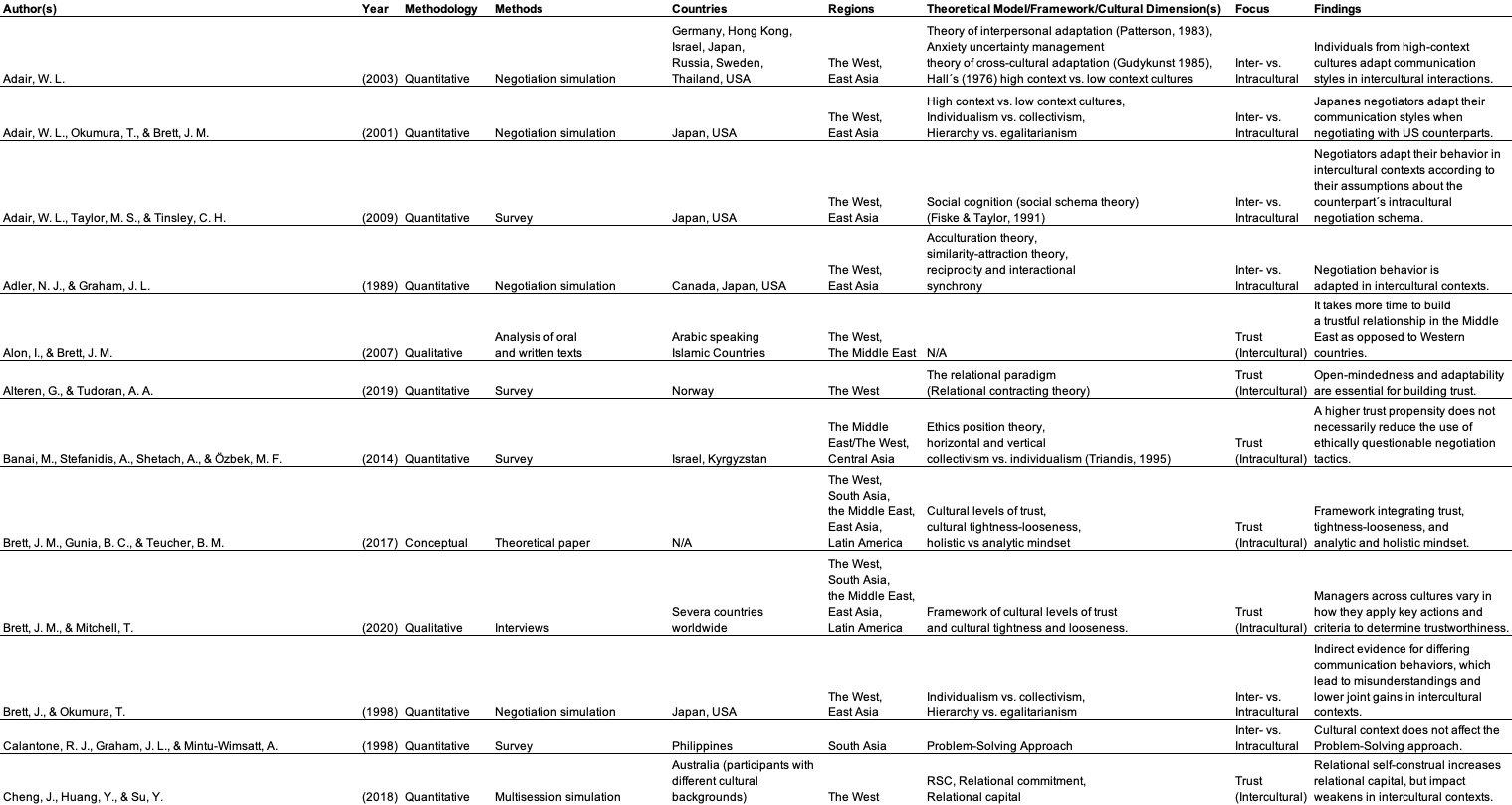


Appendix C: Trust Scores

*Sorting: Low-trust to high-trust
**Defined as in-group (your neighbourhood) – out-group (another nationality)
Data Sources: Wave 7: Haerpfer et al. (2022); Wave 4-6: Inglehart et al. (2014)