“One thing that business scholars and business people are in complete agreement on is that everyone negotiates nearly every day.”
(Thompson, 2015)
“Like it or not, you are a negotiator. Negotiation is a fact of life. (...) Everyone negotiates something every day.”
(Fisher et al., 2011)
“People negotiate all the time.”
(Lewicki et al., 2020)
As these quotes illustrate, canonical negotiation papers in management, psychology, law, economics, political science, and other fields assert that negotiation is an integral, often dreaded, yet crucial aspect of human interactions (see Supplemental Materials, Note 1, Table S1 for a sample list). Negotiation scholars thus portray negotiations as a frequent activity that permeates people’s social lives. But while negotiation journal articles and textbooks highlight the ubiquity and importance of negotiation, its prevalence and its associations with momentary emotions and overall well-being in everyday life remain largely unknown. How often do people try to shape agreements, convince others to think or act a certain way, navigate conflict, or bargain in daily life? How do people feel when they negotiate? And how is negotiation frequency associated with their overall well-being? The present study examines three widely-held assumptions about negotiation that - as far as we know - have not yet been tested outside the confines of a laboratory: (1) negotiation is a daily activity, (2) negotiation is generally unpleasant, and yet (3) negotiation is associated with better long-term well-being. We use an app-based experience-sampling methodology (MindSampler: www.mindsampler.com and see Supplemental Materials, Note 2 for more details), where participants log and rate their negotiations and affective states as they occur in real time. This provides the first comprehensive examination of negotiation in everyday life and its implications for both short-term pleasantness and longer-term well-being.
Theoretical Background and Hypotheses
Untested Assumption #1: “We Negotiate Every Day”
Negotiations, defined as social interactions aimed at reaching an agreement that improves the status quo (Carnevale & Pruitt, 1992), are distinct from other interactions. Negotiations are goal-driven interactions (Galinsky & Mussweiler, 2001) with diverging interests (Pruitt, 1998), that require strategic communication to achieve these goals (e.g., Bowles & Babcock, 2013; Lee & Ames, 2017; Schaerer et al., 2020; Trötschel et al., 2015). Just as conversations may serve a variety of objectives, such as creating mutual understanding, cultivating a positive impression, or merely providing entertainment (Yeomans et al., 2022), negotiations too can serve a spectrum of objectives that span from persuasion to navigating conflict. Existing scholarship, however, lacks a comprehensive taxonomy of the different types of interactions that fall under the negotiation umbrella. We propose eight non-mutually exclusive types that capture recurring forms of negotiation processes across everyday interpersonal interactions.
We identified these processes using two complementary approaches. First, we conducted an interpretive qualitative review of research in leading negotiation journals to identify recurring themes that fall under the negotiation umbrella. The goal was to ensure that each proposed process reflects a distinguishable emphasis in the literature, even if processes overlap in practice. Second, we used a bottom-up, data-driven approach to assess whether these processes are reflected in how negotiation is described outside academic work by analyzing negotiation books.
Specifically, we compiled a corpus of 475 English-language negotiation books (titles and descriptions). We embedded book titles and descriptions using BERTopic (Grootendorst, 2022) and then assessed whether each process was represented in the corpus using semantic similarity. Each process was operationalized as a prototype vector by averaging embeddings across multiple paraphrases of its definition. We computed cosine similarity between each book embedding and each process prototype. All eight processes showed meaningful representation in the corpus (see Table S2 for examples of books that were the best match for each process). Several processes showed broad coverage, including Reach an agreement (216 books), Bargain over something (201 books), and Act as a mediator (183 books). More specific processes also showed meaningful coverage, including Make a joint decision (58 books), Convince someone to see things my way (35 books), and Convince someone to do something (10 books). Overall, 274 of the 472 books with usable descriptions (58%) exceeded a cosine similarity of 0.50 for at least one process, suggesting that a majority of the corpus emphasizes content aligned with one or more processes of the proposed framework. The remaining books were primarily context-specific (e.g., real estate, salary negotiation, parenting, or geopolitical negotiations): they involve negotiation but are
Table 1 Negotiation Processes
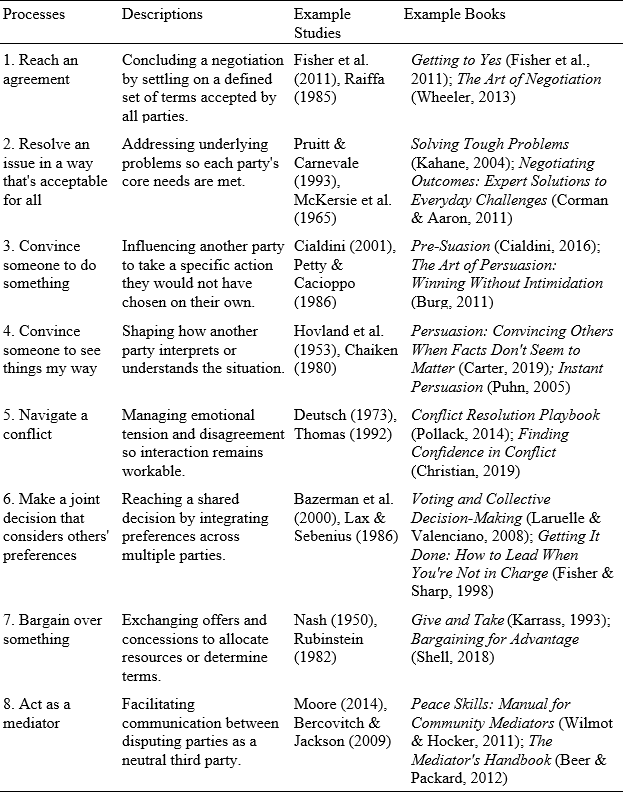
organized around setting rather than negotiation process (see Supplemental Materials, Note 3 for details of corpus construction, analytic steps, and results, as well as the Supplemental Excel and Python files for data and code).
Together, the qualitative review of scholarly work and the book-corpus semantic analysis suggest that these eight processes capture meaningful distinctions within the negotiation space. They are not intended to be exhaustive or mutually exclusive. Instead, they provide a compact set of broad, recurring, and non-redundant negotiation processes suited to measurement in mobile-based experience sampling designs.
While current scientific and popular negotiation works span a wide range of processes, research on the prevalence of negotiation behavior has primarily focused on factors influencing individuals' propensity to initiate negotiations in laboratory or vignette studies. For instance, researchers have examined the impact of emotions (Kapoutsis et al., 2017; Kong et al., 2011), social incentives (Bowles et al., 2007), power dynamics and legitimacy (Lammers et al., 2008; Magee et al., 2007), and skills (Volkema et al., 2013) on the tendency to initiate a negotiation. Individual differences such as personality traits (Elfenbein, 2015; Sharma et al., 2018), risk aversion (Marks & Harold, 2011), attitudes toward bargaining (Lee, 2000), and cultural differences (Lee, 2000; Volkema & Fleck, 2012) have also been linked to people’s self-reported propensity to negotiate.
Very few studies provide insights into the prevalence of negotiation in real life, and existing research focuses on highly specific situations, such as job offers and home, car, or souvenir purchases (Schweinsberg et al., 2022). We conducted a search for “daily negotiations”, and found no studies on this. For instance, two studies have examined the propensity of recent college graduates to negotiate their job offers and found that negotiation was relatively frequent (20% to 25% of participants negotiated) with situational factors such as the attractiveness of initial offers, the number of available alternatives, and prior work experience affecting negotiation initiation (Gerhart & Rynes, 1991; O'Shea & Bush, 2002). Likewise, analyses of residential property transactions in England show that negotiation is common: two-thirds of potential buyers who have their first offer turned down continue negotiating with the seller (Merlo & Ortalo-Magne, 2004). Among car buyers, between 70% of US buyers (Rechtin, 2016) and 29% of UK buyers (Mazuru, 2023) attempt to negotiate better prices for their cars. Finally, 71% of tourists seem to negotiate (Kozak et al., 2017). In another study (Solon, 2013), 19 out of 20 tourists (95%) negotiated after learning information about prices.
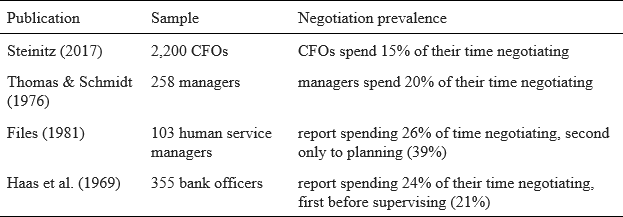
While these studies suggest that negotiation behavior–especially bargaining–is commonplace in clearly-defined contexts, the extent to which people negotiate every day and which negotiation processes are more prevalent remains unknown. When we searched the literature for time-tracking studies as empirical evidence of negotiation prevalence, we could only identify four studies (Table 2). In addition, these studies are not overly informative because they focus on a selective subset of the population (managers), are based on retrospective self-reports, and might be considered dated. The estimates for how much managers negotiate in these studies range from 15% (Steinitz, 2017) to about 25% (Files, 1981; Haas et al., 1969) of their working time. Observational studies (Mintzberg, 1973; Kurke & Aldrich, 1983) characterize negotiation as one of the most common managerial activities but have been criticized for small sample size (Mintzberg 1973 is based on five executives), lack of rigor, and contrasting findings when different operationalizations are used (Luthans, 1986). Thus, it seems that we currently do not know how frequently people negotiate or what people actually do when they negotiate. By exploring the frequency and processes of negotiation that individuals experience daily, we present a more realistic perspective on the negotiation landscape.
Table 2 Negotiation Prevalence Across Studies
Untested Assumption #2: “Negotiation is Associated with Unpleasantness”
Negotiation is commonly portrayed as a dreaded, unpleasant emotional experience for most people. And there is indeed indirect evidence to suggest that engaging in negotiation is associated with short-term affective costs. Negotiation, by its nature, sometimes involves actual conflict and confrontation, which can elicit discomfort, anger, and anxiety in the short term (see Lindner, 2006 for review). It also often involves perceived conflict. People often view negotiations as zero-sum, seeing one party’s gains as offset by other parties’ losses (Bazerman & Neale, 1983; Johnson et al., 2022; Różycka-Tran et al., 2015), and the more they hold these zero-sum beliefs, the more individuals worry that negotiations lead to conflictual interactions (Davidai et al., 2022) and harmful outcomes (Hart et al., 2024). These negative emotions can make the act of negotiating momentarily unpleasant for individuals. In fact, anticipating negative emotions during the negotiation process leads people to avoid negotiating (Kong et al., 2011; Dungan & Epley, 2024), and feeling nervous increases the likelihood that people will exit a negotiation soon after it starts (Brooks & Schweitzer, 2011).
People also dread the prospect of asking. Individuals often worry about imposing on others, appearing overly aggressive, revealing their own shortcomings, and the possibility of rejection (DePaulo & Fisher, 1980; Milgram & Sabini, 1978). Common misperceptions exacerbate this fear: individuals tend to underestimate the positive regard their negotiation counterparts may have for them (Ames & Wazlawek, 2014) and overestimate the inconvenience they impose on others when making requests (Bohns & Flynn, 2010; Bohns, 2016; Zhao & Epley, 2022).
Despite the indirect evidence suggesting a general dislike of negotiation, there is a striking lack of direct empirical evidence examining this notion that negotiation is associated with unpleasantness in everyday life. Much of the existing research has been conducted in controlled laboratory settings (Jang et al., 2018), where participants negotiate with strangers. Therefore, whether the statement "most people dislike negotiating" holds true beyond the confines of a laboratory remains an open question.
Untested Assumption #3: “Negotiating Links to Better Well-being”
While negotiation may carry short-term affective costs, individuals who negotiate may reap long-term benefits that make them better off.
One key reason for this could be that negotiation can improve social relationships (Delatorre & Wagner, 2019; Kurdek, 1995). The quantity and quality of social relationships are presumably the most important contributors to happiness under people’s control (Quoidbach et al., 2019). As individuals negotiate more frequently, they become more adept at handling conflict, understanding others' perspectives, and finding mutually satisfactory solutions (Cross, 1977; Thompson, 1990). These skills, honed through repeated practice, could be associated with healthier and more satisfying relationships. Providing indirect evidence for the idea that negotiation links to better well-being, studies indicate that passive responses to interpersonal conflicts, such as avoidance, can increase stress and strain, and even exacerbate depressive symptoms (Dijkstra et al., 2009; Pettit & Joiner, 2006; Marchand & Hock, 2000). Frequent negotiators who proactively resolve conflict, are potentially less prone to these negative emotional outcomes and may enjoy more satisfying social interactions and higher well-being.
Negotiations might also enhance self-esteem and self-efficacy. Each successful negotiation serves as a testament to an individual's capability to advocate for themselves and navigate complex situations. This self-efficacy is not merely a transient feeling but can have a lasting impact: Curhan et al. (2009) found that individuals' self-perceptions during job offer negotiations significantly predicted their job satisfaction, compensation satisfaction, and turnover intentions one year after the negotiations had concluded. The confidence derived from successful negotiations could be related to increased self-esteem, which in turn could boost people’s happiness and buffer against depression (Baumeister et al., 2003; Cheng & Furnham, 2003). Conversely, in the long run, habitually avoiding negotiations could be associated with feelings of helplessness, stagnation, and even depression as individuals fail to address conflicts and have their needs unmet (e.g., Abramson et al., 1989; Hayes et al., 1996; Kashdan et al., 2008).
Lastly, frequent negotiation can be associated with important life outcomes. Frequent negotiators are more likely to advocate for better salaries, secure promotions, and steer their career paths in alignment with their personal aspirations. Such control over one's life circumstances, along with the tangible benefits that negotiation can yield (Babcock & Laschever, 2003), can be positively related to a sense of fulfillment and pleasantness.
The connections between negotiation, better social relationships, self-esteem, and improved life outcomes make a persuasive argument for the idea that individuals who negotiate more frequently may link to better well-being. However, this hypothesis has not yet been tested.
Present Study
This study seeks to enrich our understanding of negotiation in everyday life. We leverage an experience-sampling design to overcome traditional constraints, such as social desirability and recall biases (Fisher & To, 2012), and explore the frequency and emotional impacts of negotiations across different contexts.
Furthermore, our study explores how basic demographic differences play out in everyday situations. One of the most debated individual differences in negotiation research is gender (Babcock et al., 2006; Small et al., 2007; Kugler et al., 2018), giving rise to the notion that "women don't ask" (Babcock & Laschever, 2003). Some studies find evidence that men initiate salary (Babcock et al., 2006; Bowles et al., 2007), promotion (Crothers et al, 2010), or car price negotiations (Chandra et al., 2017) more than women, particularly when the opportunity isn't explicitly presented (Leibbrandt & List, 2015). Yet, recent studies challenge this view (Säve-Söderbergh, 2019), and Kray et al. (2024) report a reversal of this effect in salary negotiations. Age is another factor; older adults might prefer waiting out conflicts, while younger people tend to address them actively (Davis et al., 2009). This difference extends to situations like car purchases, where older buyers pay more (Chandra et al., 2017). Our work explores these dynamics in daily life, beyond the controlled settings of previous studies.
Method
Participants
A total of 350 participants were recruited via the Prolific online platform. Inclusion criteria required participants to be at least 18 years old, from the U.K. or U.S., and possess a smartphone compatible with MindSampler (https://www.mindsampler.com), an experience-sampling app for iOS and Android. Participants provided informed consent and received a £1 compensation for installing the app and completing an initial sign-up survey (demographics and well-being). Participants were then paid £0.15 per experience-sampling survey completed over the next seven days (paid as a single bonus at the end of the study). Additionally, a bonus of £10 was awarded to the three participants with the most surveys completed, with a random draw in case of a tie. The final sample comprised 302 participants who completed at least one experience-sampling survey (105 females, 194 males, 3 other/prefer not to say), with a mean age of 25.1 years (SD = 11.4). On average, participants completed 17.5 (SD = 15.1) experience-sampling surveys (Nsurveys = 5286).
Procedure
Participants downloaded the MindSampler app which sent push notifications to their smartphones at random times throughout the day. Each notification opened a brief Qualtrics questionnaire displayed seamlessly within the app. Participants were required to complete these questionnaires within 15 minutes of receiving the notification to ensure the accuracy and relevance of their responses (Myin-Germeys & Kuppens, 2021). As preregistered, questionnaires completed after 15 minutes of receiving notifications did not count toward participants’ compensation and were not included in the analysis. Participants could set their preferred number of daily notifications (from 1 to 12) and time window in the app. The default was 3 notifications a day, each day of the week from 8 AM to 10 PM.
Measures
Long-term Well-being. We assessed participants' overall well-being at initial sign-up, using the World Health Organization Well-Being Index (WHO-5; Topp et al., 2015) and the Patient Health Questionnaire-9 (PHQ-9; Kroenke et al., 2001). The WHO-5 is a brief scale that evaluates how often participants experience indicators of subjective well-being, including positive mood, vitality, and general interest, using five questions, scored from 0 (at no time) to 5 (all of the time). The PHQ-9 quantifies depressive symptom severity through nine items reflecting DSM-IV criteria, scored from 0 (not at all) to 3 (nearly every day), with higher scores denoting more severe symptoms. Both scales were measured at the start of the study to reduce focalism effects (i.e., broad life evaluations being disproportionately influenced by immediately preceding questions about momentary states or salient experiences; Schwarz & Strack, 1999). We treat these measures as relatively trait-like over the study window.
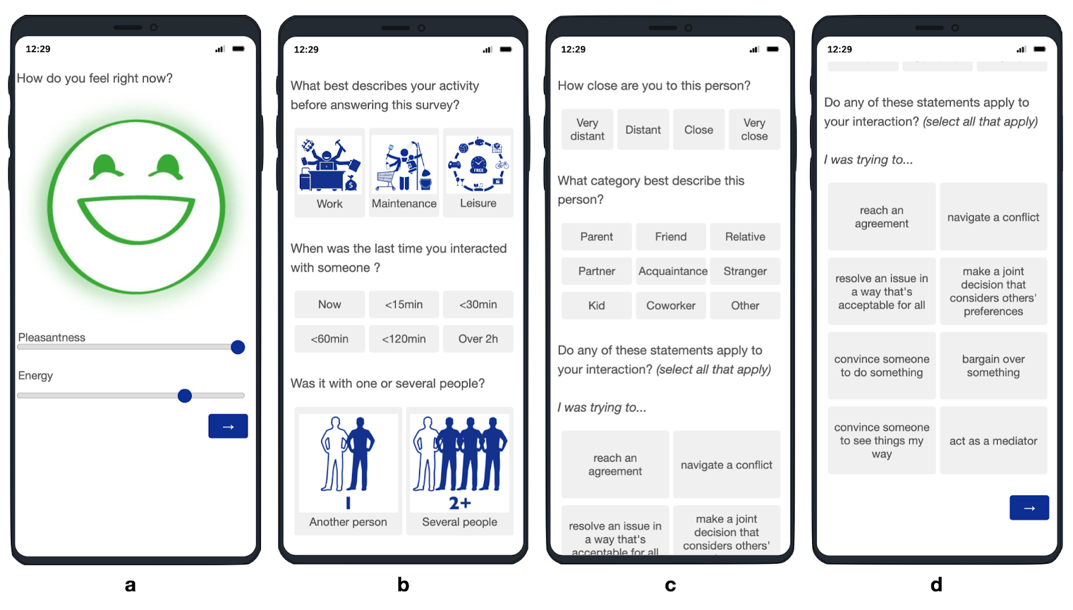
Short-term Pleasantness. Participants began each survey by rating their current level of affect on a two-dimensional 5-point graphic slider measuring valence and arousal (see Figure 1a). As pre-registered, the present study focuses on pleasantness (i.e., the valence dimension).
Current Activity. Next, participants picked what best described their main activity before answering the survey using three mutually exclusive categories: work, maintenance, and leisure (see Figure 1b). Various classification systems for human activity have been developed by research bodies and governments worldwide, reflecting regional and cultural specificities (e.g., American Time Use Survey; Harmonised European Time Use Surveys). We chose these three fundamental categories because participants understand them easily, because they consistently emerge across systems, and because they align with classical economic and sociological theories of time allocation (Becker, 1965; Bianchi et al., 2000; Aguiar & Hurst, 2007). Work refers to professional or income-generating activities. Maintenance refers to tasks necessary for the sustenance of daily life and households, including self-care and childcare. Leisure refers to discretionary activities performed for enjoyment, relaxation, or personal enrichment. These categories were illustrated with pictograms.
Recent Social Interactions. Participants then reported the time elapsed since their last interaction with someone using one of six response options: “now,” “less than 15 min ago,” “less than 30 min ago,” “less than 1 hour ago,” “less than 2 hours ago,” “over 2 hours ago.” If participants reported an interaction within the last two hours, they further rated how close they felt to the person or people involved on a 4-point scale, ranging from 1 (not close at all) to 4 (very close), and were asked to select the main social category they belonged to from nine non-mutually exclusive options: parent, partner, kid, coworker, stranger, acquaintance, friend, relative, and other (see Figure 1c).
Participants in experience-sampling studies are often asked whether they are currently engaged in an activity (e.g., Quoidbach et al., 2019). Instead, we asked participants about the time elapsed since their last interaction because we were concerned that participants might not respond to notifications while in the midst of intense negotiations. By asking about the time since the last interaction, we aim to mitigate potential response bias and estimate the frequency and pattern of negotiations in everyday life more accurately. Furthermore, using a two-hour maximum time window allows us to strike a balance between capturing more interactions and accurate information reporting (Ellison et al., 2020; Radvansky et al., 2022).
Negotiation Processes. Finally, participants evaluated whether any of the following eight processes applied to their last reported interaction: (1) reach an agreement, (2) resolve an issue in a way that's acceptable for all, (3) convince someone to do something, (4) convince someone to see things my way, (5) navigate a conflict, (6) make a joint decision that considers others' preferences, (7) bargain over something, and (8) act as a mediator. Participants could select multiple processes if applicable (see Figure 1d). To avoid potential variation in interpretation, we did not use the term "negotiation" with participants. Instead, we assessed the eight specific negotiation processes.
Figure 1 Visuals of the Experience-Sampling Survey in the MindSampler App
Pre-registered Analyses and Exclusion Rules
We note two deviations from our pre-registration.1 First, we initially aimed to recruit 200 participants on Prolific and 50 MBA students. However, we did not manage to recruit MBA students as planned. Therefore, we recruited additional participants on Prolific (total N = 302) and did not explore the differences between the two populations outlined in the secondary analyses section of our pre-registration. Second, we preregistered multilevel logistic regression with random intercepts for participants (moments nested within participants) to estimate the frequency of each negotiation behavior. Our preregistered plan was to convert the fixed intercept to a probability, p = exp(β₀) / (1 + exp(β₀)). However, in a logistic random-intercept model this is a conditional (subject-specific) probability for a participant with u = 0, not the population-average prevalence. Because our data showed substantial between-person heterogeneity (ICCs up to .46) and low base rates for most specific behaviors, the conditional probability can be noticeably smaller than the population-average prevalence (Hedeker, 2008; Zeger et al., 1988). In practice, this produced an impossible pattern: the sum of the estimated frequencies of the specific behaviors was lower than the estimated frequency of reporting any negotiation behavior, even though “any negotiation” is a composite of the specific behaviors. To address this, we computed marginal probabilities using Monte Carlo simulation, integrating over the distribution of random effects (see hereafter). We report these estimates in the main manuscript; the original pre-registered estimates are available in the Supplemental Materials (25.75% for any negotiation behavior; see Note 4 and Figure S1 for the full breakdown).
Frequency of Negotiation in Everyday Life. To estimate the population-level frequency of negotiation in everyday life, we analyzed all reported social interactions (Ninteractions = 4384). We fitted multilevel logistic regression models using the lme4 package for R (Bates et al., 2015) with a random intercept of participants to accommodate varying numbers of observations provided by each participant. We ran one overall model predicting the probability that a social interaction includes any negotiation process and eight specific models for each process, respectively. We computed marginal (population-average) probabilities using Monte Carlo simulation, integrating over the distribution of random effects (10,000 draws). This approach yields estimates consistent with observed frequencies while accounting for the nested data structure. Note that since participants could endorse more than one process within the same interaction, the total across specific negotiation processes exceeds the prevalence of “any negotiation.”
Co-occurrence of the Negotiation Processes. To examine how negotiation processes related to one another at the moment level, we estimated a partial within-person correlation network, a contemporary approach for modeling co-occurrence in experience sampling data with a nested structure (Epskamp & Fried, 2018). Initially, each negotiation behavior was person-mean centered by subtracting individual participants' mean levels from their momentary observations. This procedure effectively removes between-person variance, allowing the resulting network to reflect within-person associations across interactions, rather than stable individual differences (Bolger & Laurenceau, 2013). Subsequently, partial correlations among the person-mean–centered variables were computed using the pcor function in R (Kim, 2015). To mitigate spurious associations arising from sampling variability, Least Absolute Shrinkage and Selection Operator (LASSO) regularization was applied using the EBICglasso algorithm. This method optimally selects the regularization parameter (λ) via the Extended Bayesian Information Criterion (EBIC), shrinking weak or unreliable edges to zero. The EBIC tuning parameter γ was set to .75, resulting in a conservative and sparse network.
Negotiation and Short-term Pleasantness. To evaluate the relationship between negotiation and short-term changes in pleasantness, we followed procedures outlined by Taquet and colleagues (2016). We first created lagged pairs of observations (t-1 and t) for each participant, focusing on pairs of observations during which the participant reported involvement in social interaction between the two measurement times (t-1 < interaction ≤ t). Imagine, for instance, a participant who completed four questionnaires. On the first questionnaire (10:00 AM), she reports interacting now. On the second questionnaire (2:00 PM), she reports having interacted less than an hour ago. On the third questionnaire (3:30 PM), she reports having interacted over 2 hours ago. Finally, on the fourth questionnaire (6:00 PM), she reports having interacted less than 30 min ago. In this case, we would create a first pair of observations for this participant in which Questionnaire 1 (10:00 AM) is labeled t-1 and Questionnaire 2 (2:00 PM) is labeled t, since an interaction happened in between (around 1:30 PM). We would not create a pair of observations between Questionnaires 2 and 3 since an interaction did not occur between the two measurement points. We would, however, create a second pair of observations for this participant in which Questionnaire 3 (3:30 PM) is labeled t-1 and Questionnaire 4 (6:00 PM) is labeled t, since an interaction happened in between (around 5:45 PM).
Next, we computed the mean difference in past and current pleasantness (∆H = Ht - Ht-1) for each pair of observations and used these change scores as our dependent variable in multilevel regression. Our main predictor was whether participants reported any negotiation processes during the interaction (0 = no; 1 = yes), and our control variables included the time of day, categorized into twelve 2-hour periods (ranging from 0:00:00 AM–1:59:59 AM to 10:00:00 PM–11:59:59 PM), the day of the week (distinguishing between weekdays and weekends), the social categories of people involved in the interaction (one dummy variable of each of the nine categories), the current activity reported by the participant, and latency effects. The latter accounts for the fact that interactions can span multiple measurement points and controls for the social interaction (nine dummy social category variables) and negotiation participants may have been involved in at the previous time point (t-1). Our model included a random intercept of participants to account for the nested structure of the data, with participants each providing multiple pairs of observations. The dependent variable– change in mood– is scaled in the regression model. Additional control variables are included in the model and can be found in Table 3.
Negotiation and Longer-term Well-Being. To evaluate the relationship between negotiation and longer-term well-being, we computed the average frequency of negotiation for each participant across their reported social interactions. We then used this metric to separately predict well-being and depression on the WHO-5 (5-point Likert scale, mean = 2.78, SD = 1.04) and PHQ-9 (4-point Likert scale, mean = 0.68, SD = 0.60) scales, respectively. Neither of these two scales has reverse-coded items, and they have coefficient omega totals of .92 and .92, respectively. All analyses were conducted using standardized (scaled) scores. To ensure that obvious individual differences do not confound the relationship between one’s propensity to negotiate and well-being, we control for age, gender, the average frequency of interactions across different partner categories (Parent, Partner, Kid, Coworker, Stranger, Acquaintance, Friend, Relative, Other), the average closeness ratings attributed to these interactions, and the average frequency of daily activities (maintenance, work, and leisure). Additionally, to ensure the integrity of our measures of well-being, we excluded participants who omitted more than one item on the WHO-5 and PHQ-9 scales. All control variables and exclusion criteria were preregistered.
Results
Frequency of Negotiation in Everyday Life
Our analyses revealed that 33.55%, (95% CI [29.53, 36.48]) of all reported social interactions involved at least one process of negotiation. The frequency of each negotiation process is depicted in Figure 2. There were no significant gender (b = -0.425, z = -1.723, p = .085) and age (b = 0.002, z = .154, p = .88) differences in the prevalence of negotiation (see Supplemental Materials, Note 5, Table S3 and Figure S2 for a detailed breakdown).
Within each interaction type, negotiations occur most frequently among conversations with coworkers. About 54% of interactions with coworkers involve negotiation, followed by relatives (31%), friends (31%), romantic partners (29%), parents (28%). As an exploratory analysis, we used a multi-indicator GLMM to examine negotiation likelihood across relationship types, with all relationship categories entered simultaneously as binary fixed effects and random intercepts for participants. The intercept reflects the baseline log-odds for interactions outside all specified categories. Controlling for all other types of interaction partners, interactions with friends were less likely to involve negotiation processes (b = -0.57, 95% CI [-0.95, -0.20], z = -3.01, p = .003), as were interactions with romantic partners (b = -0.46, 95% CI [-0.74, -0.15], z = -2.99, p = .003) and parents (b = -0.52, 95% CI [-0.90, -0.14], z = -2.70, p = .007). In contrast, interactions with coworkers were more likely to involve negotiation (b = 1.33, 95% CI [0.96, 1.66], z = 7.25, p < .001). Other social categories did not relate to negotiation (all ps >. 09). See Note 6 (Table S4 and Table S5) in the Supplemental Materials for more details regarding the propensity and absolute frequency of negotiations across different partner types, respectively and Figure S3 for a visual representation of the frequency breakdown by partner types.
Figure 2 Frequency and Co-occurrence of Negotiation Processes in Daily Interactions.
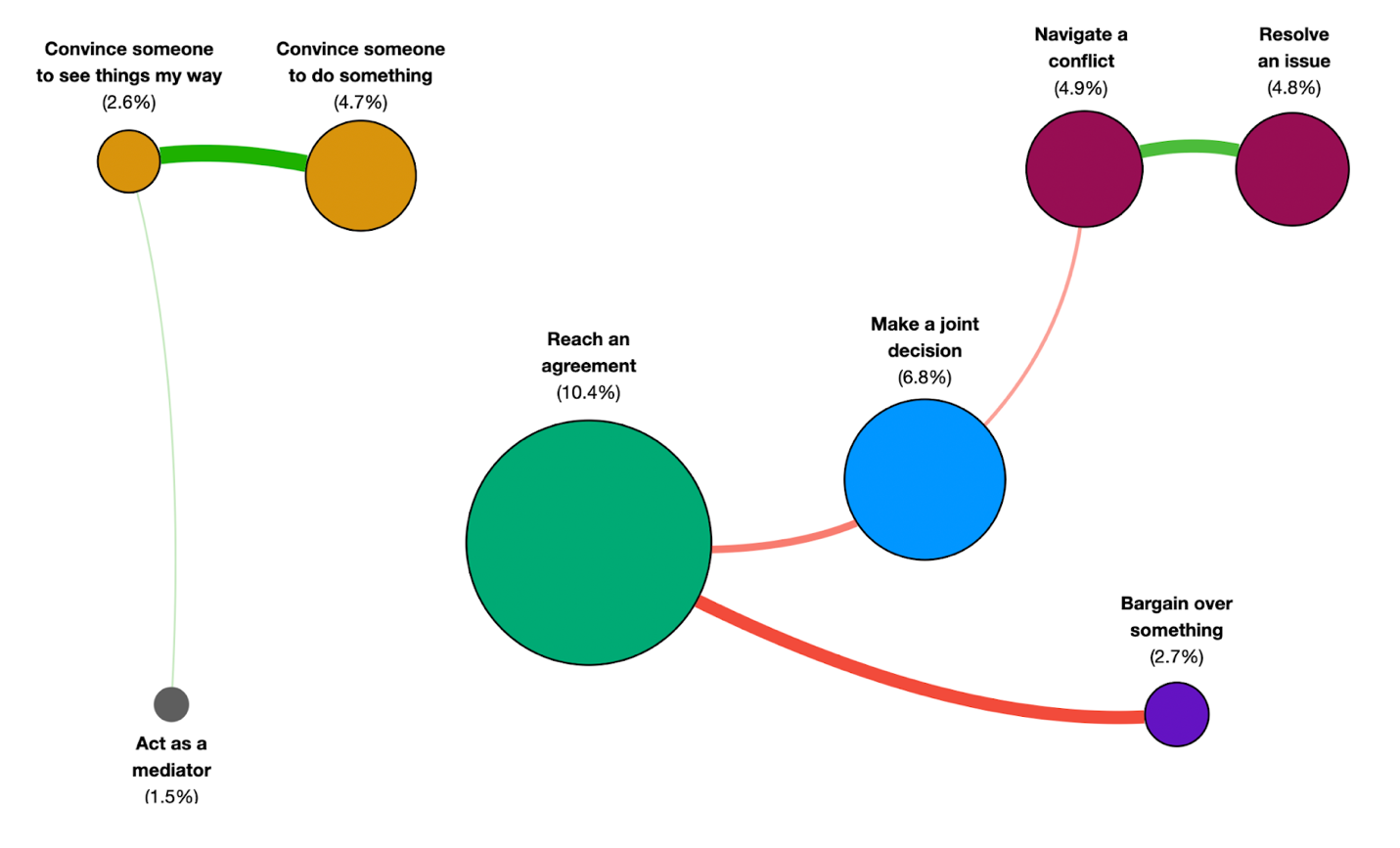
Note. Circle size indicates the relative frequency of negotiation processes in daily interactions (raw percentages shown in parentheses). Colors depict broader clusters of negotiation processes. Edges represent within-person partial correlations after LASSO regularization, with green indicating positive associations and red indicating negative associations.
Co-occurrence of the Negotiation Processes
Figure 2 illustrates the resulting network, comprising eight nodes (negotiation processes) and six edges (partial correlations) that survived regularization. Edge weights represent the strength of within-person partial associations while controlling for all other processes in the network. Green edges indicate processes that tend to co-occur within individuals over time, whereas red edges denote processes that tend not to co-occur.
These results suggest six broader clusters of negotiation processes. Persuasion attempts cluster together, encompassing efforts to convince others either to take a specific action or to adopt a particular viewpoint. Conflict management also emerges as a distinct cluster, including both navigating and resolving conflict.
Reaching an agreement is the most frequently reported process. Notably, it is negatively correlated with both joint decision-making and bargaining. This pattern is consistent with the idea that negotiation interactions may be experienced through different situational orientations or styles (e.g., compromise-oriented, cooperative, or competitive), with most interactions being described primarily in terms of a single dominant orientation. Accordingly, the observed negative correlations may reflect mutual exclusivity in how participants described their experiences rather than true opposition in underlying negotiation processes.
Finally, acting as a mediator is rarely reported and appears largely isolated in the network, suggesting that it is perceived as an uncommon and qualitatively distinct process within negotiation interactions.
Negotiation and Short-term Pleasantness
Results from our time-lagged multilevel linear regression with participant as a random-intercept revealed that compared to social interactions that did not involve negotiation, interactions that included at least one negotiation process were associated with lower momentary pleasantness (b = -0.19, 95% CI [-.27, -.11], t = -5.30, p < .001). This effect was not moderated by gender (bnegotiating*gender = .05, 95% CI [-.09, .18], t = 0.67, p = .50) or age (bnegotiating*age = -.004, 95% CI [-.01, .002], t = -1.31, p = .19). All models included random intercepts for participants to account for within-person dependencies. To ensure robust inference against potential model misspecification, we report significance tests based on cluster-robust standard errors (CR2 method; Pustejovsky & Tipton, 2018) with participant ID as the clustering variable. The results remained similar (b = -.19, 95% CI [-.27, -.11], t = -4.53, p < .001). Detailed regression results can be found in Table 3 and see in Supplemental Materials, Note 7 (Tables S6 & S7) for a breakdown of the effect across each negotiation process cluster, and counting negotiation occurrences as a negotiation intensity measure.
Table 3 Linear Mixed Model Predicting Changes in Short-Term Pleasantness
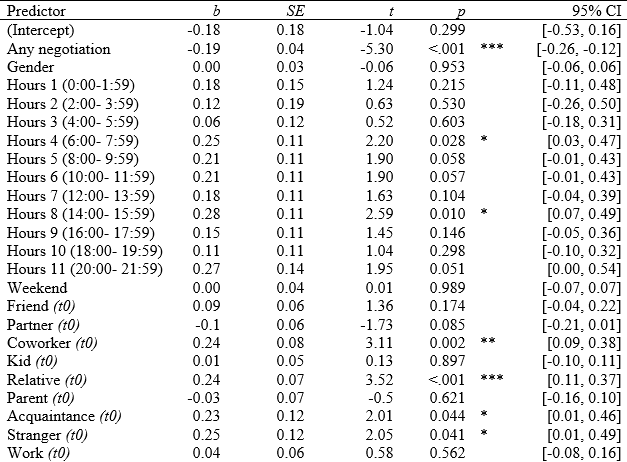
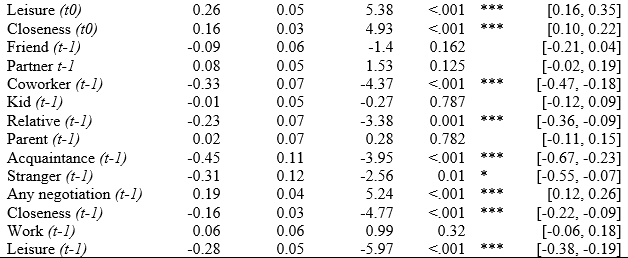 Note. All variables used in the multi-level regression model to predict the short-term pleasantness change from having a negotiation interaction. N = 4,062. Coefficients are standardized with respect to the outcome variable (in SD units of mood change). Predictors remain in their original units. 95% confidence intervals (CIs) computed using the standard error. Any negotiation coded 0 = no negotiation occurred, 1 = negotiation occurred (with any partner or process). Partner-type dummy variables (Parent, Partner, Kid, Coworker, Stranger, Acquaintance, Friend, Relative) coded 0 = interaction did not involve that partner type, 1 = interaction involved that partner type. Gender coded 0 = men, 1 = women. Asterisks indicate statistical significance: p < 0.001: ***, p < 0.01: **, p < 0.05: *.
Negotiation and Longer-term Well-Being
Our results suggest that negotiation was associated with lower short-term affect pleasantness. But what about longer-term well-being? Participants’ overall frequency of negotiation across their social interactions was significantly associated with general well-being (b = 0.44, 95% CI [0.01, 0.87], t = 2.01, p = .046), over and above age, gender, the average frequency of interactions across different partner categories, the average closeness ratings attributed to these interactions, and the average frequency of daily activities. A similar, but separate regression model was conducted on the depression measure. Although directionally consistent, the overall frequency of negotiation did not significantly relate to lower depression symptoms using the PHQ scale as the dependent variable (b = -0.35, 95% CI [-0.78, 0.08], t = -1.58, p = .12). Detailed regression outcomes can be found in Table 4 and see in Supplemental Materials, Note 7 (Tables S6 & S7) for a breakdown of the effect across each negotiation process cluster, and counting negotiation occurrences as a negotiation intensity measure. Again, none of these relationships were moderated by gender (well-being: bnegotiation*gender = 0.16, 95% CI [-0.72, 1.04], t = 0.35, p = .729; depression: bnegotiation*gender = 0.03, 95% CI [-0.85, 0.91], t = 0.08, p = .939) or age (well-being: bnegotiation*age = 0.01, 95% CI [-0.03, 0.05], t = 0.50, p = .618; depression: bnegotiation*age = -0.002, 95% CI [-0.04, 0.04], t = -0.11, p = .909).
Table 4 Linear Regression Model Predicting WHO-5 (Well-being)
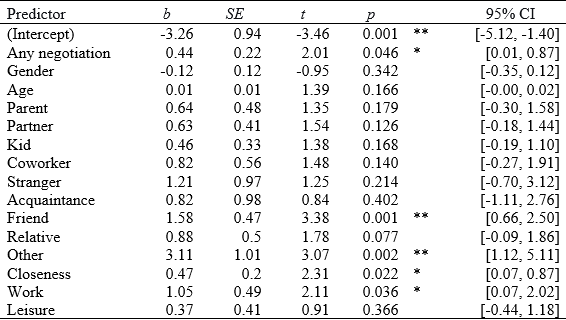
Note. All variables used in the linear regression model to predict longer-term well-being from having negotiation interactions. N = 246. R² = .14, Adjusted R² = .08, F(15, 230) = 2.43, p = .003. Coefficients are standardized with respect to the outcome variable (in SD units of well-being). Predictors remain in their original units. Any negotiation coded 0 = no negotiation occurred, 1 = negotiation occurred (with any partner category). Partner-type dummy variables (Parent, Partner, Kid, Coworker, Stranger, Acquaintance, Friend, Relative, Other) coded 0 = interaction did not involve that partner type, 1 = interaction involved that partner type. Gender coded 0 = men, 1 = women. The 95% confidence intervals (CIs) are computed using the standard error. Asterisks indicate statistical significance: p < 0.001: ***, p < 0.01: **, p < 0.05: *.
General Discussion
We used an app-based experience-sampling methodology to examine empirically three widely-held, but previously untested assumptions about negotiation: (1) we negotiate every day, (2) negotiations often feel unpleasant in the moment, yet (3) engaging in negotiation relates to higher well-being. Our results, based on everyday life data, corroborate these three ideas.
First, we found that negotiation is indeed ubiquitous: one third of all interactions involved some form of negotiation. Second, among individuals who reported negotiating, negotiation was associated with lower short-term pleasantness (0.19 SD). To put this association in perspective, the strongest correlation of momentary pleasantness in our data was engagement in leisure activities, which was associated with 0.27 SD higher short-term pleasantness. Interacting with coworkers or relatives was associated with 0.24 SD higher pleasantness, and greater closeness to the interaction partner was associated with 0.16 SD higher pleasantness. In terms of momentary pleasantness, negotiation was therefore comparable in magnitude, but opposite in direction, to interacting with coworkers or relatives.
Finally, despite the short-term affective associations, our data suggest that negotiation may not be associated with lower long-term well-being. On the contrary, people who negotiated more frequently reported higher overall well-being (fully standardized β = 0.12), an association about half the size of that observed for overall friend interaction frequency, the only significant predictor of longer-term well-being in our data that was a specific relationship type (fully standardized β = 0.24). We note, however, that this association is cross-sectional and does not imply causation. For example, individuals higher in trait well-being may be more likely to negotiate and may also experience negotiation as less affectively unpleasant in the moment. With this caveat in mind, these findings are consistent with the view that negotiation, while sometimes daunting, is a fundamental part of everyday life. Although negotiation is often assumed to be a skill reserved for boardroom settings and executive roles, our findings suggest that it is linked to well-being across the broader population and across a wide range of everyday social contexts.
Our analyses further examine the distribution of negotiation across social categories and processes, providing a richer understanding of negotiation’s role in daily life. We found that “reaching an agreement”, presumably to avoid an impasse (Schweinsberg et al., 2022), was the most common negotiation activity, occurring in about 10.4% of interactions. In contrast, “bargaining over something” was less common, appearing in only 2.7% of interactions. Ironically, the typical image of negotiation is precisely this kind of zero-sum bargaining (Davidai & Tepper, 2023), a notion that is extensively covered in negotiation courses with a heavy focus on distributive tactics like first offers and anchoring. The gap between common perceptions and real-world negotiation patterns raises the possibility that, although distributive negotiations may be rarer, they may be impactful and memorable when they do occur, such as negotiating the price of a house (Merlo & Ortalo-Magne, 2004) or securing a pay increase (Gerhart & Rynes, 1991; O'Shea & Bush, 2002). However, the disparity may also point to a potential misalignment in negotiation training, emphasizing the need for a more balanced approach that accurately reflects the prevalence of distributive and integrative negotiation in people’s everyday lives.
As for social categories, negotiation was most prominent in interactions with coworkers: more than half of coworker interactions involved some form of negotiation. This pattern echoes past research on the central role of negotiation in professional contexts (Bazerman & Neale, 1992). However, although negotiation was less likely to occur in personal relationships, such as interactions with friends, romantic partners, and parents, our experience sampling data suggest that it was still common in these contexts. About 30% of interactions with close personal partners involved negotiation. Because people frequently interact with close others, the absolute number of negotiations in these relationships, especially with romantic partners, was substantial. This observation points to the need for a more nuanced understanding and application of negotiation strategies in close relationships, one that recognizes the importance of preserving the emotional bonds and relational dynamics that characterize these interactions (Curhan et al., 2006).
Our study did not find evidence that gender or age were associated with how often people negotiated or how they felt when doing so. These findings challenge common stereotypes, such as the idea that men negotiate more often or that women experience greater distress during negotiation. They also align with newer research questioning the impact of gender and age on negotiation (Amanatullah & Morris, 2010; Kugler et al., 2018; Mazei et al., 2015; Kray et al., 2024). These results contribute to a growing body of literature emphasizing the need to move beyond simple categorizations based on gender and age when examining complex social behaviors like negotiation.
This study sets the stage for deeper investigations into real-world negotiations and their emotional consequences. On a descriptive level, future research could examine the interactions between situations and negotiation behaviors, specifically how different types of negotiations unfold across settings and with different partners. Future research could explore the substance of everyday negotiation and examine what subjects people commonly negotiate over, what outcomes they achieve, such as the frequency of agreements and impasses, wins and losses, and how these results might vary among different demographic groups.
Our study employed a broad measure of momentary affect to examine the emotional consequences of negotiations. Further research is needed to determine the specific and potentially complex emotions triggered by different negotiation situations to develop targeted strategies to ease the discomfort of negotiating. The effects on global well-being were relatively modest, suggesting further replication of these findings is necessary to corroborate the link between the propensity to negotiate in everyday life and well-being. Although we measured well-being at baseline, our design does not allow us to determine whether negotiation frequency predicts subsequent changes in well-being; future studies should assess well-being both before and after the experience sampling period to establish temporal precedence and strengthen causal inference. Future research could also focus on identifying how self-efficacy, improved relationships, and the accumulation of tangible resources contribute to the potential long-term well-being benefits of negotiation. Exploring how different negotiation styles, strategies, and techniques affect well-being outcomes could lead to more effective negotiation training programs that both enhance negotiation outcomes and promote psychological well-being.
Building on these future directions, it is important to recognize other limitations of our current study. First, we recruited our sample from the Prolific platform, which might not fully reflect the wider population. Future studies should aim to include a broader array of participants, particularly from varied cultural and professional backgrounds, to better understand negotiation experiences across different demographics. Second, we relied on participants' self-reported negotiation experiences. However, negotiation is inherently interactive, and perceptions of what constitutes a negotiation may differ between the parties involved. Future research could improve upon our experience-sampling approach by adding more objective measures, such as analyzing conversation excerpts through Electronically Activated Recorder (EAR; Mehl et al., 2010) or considering both parties' perspectives in a dyadic-level study. Finally, our observational design precludes causal inferences. In particular, the association we observe between negotiation and long-term well-being may reflect reverse causality. For example, individuals with higher baseline well-being may be more likely to engage in conversations (e.g., Cunningham, 1988), especially more challenging ones (Quoidbach et al., 2019). Future research could use Ecological Momentary Intervention (e.g., prompting participants to negotiate when they report being in a conversation) to establish the causal relationships between more frequent negotiation activities and increased well-being (Heron & Smyth, 2010).
In sum, our research offers empirical evidence that negotiation is a common part of daily life and is associated with both lower short-term pleasantness and higher longer-term well-being. Aligned with recent calls for more real-world negotiation research (Boothby et al., 2023; Jang et al., 2018), our findings underscore the need to better understand when, why, and how people negotiate, as well as the role everyday negotiations may play in human flourishing.
References
Abramson, L. Y., Metalsky, G. I., & Alloy, L. B. (1989). Hopelessness depression: A theory-based subtype of depression. Psychological Review, 96, 358–372. https://doi.org/10.1037/0033-295X.96.2.358
Aguiar, M., & Hurst, E. (2007). Measuring trends in leisure: The allocation of time over five decades. The Quarterly Journal of Economics, 122, 969–1006. https://doi.org/10.1162/qjec.122.3.969
Amanatullah, E. T., & Morris, M. W. (2010). Negotiating gender roles: Gender differences in assertive negotiating are mediated by women’s fear of backlash and attenuated when negotiating on behalf of others. Journal of Personality and Social Psychology, 98, 256–267. https://doi.org/10.1037/a0017094
Ames, D. R., & Wazlawek, A. S. (2014). Pushing in the dark: Causes and consequences of limited self-awareness for interpersonal assertiveness. Personality and Social Psychology Bulletin, 40, 775–790. https://doi.org/10.1177/0146167214525474
Babcock, L., Gelfand, M., Small, D., & Stayn, H. (2006). Gender differences in the propensity to initiate negotiations. In D. De Cremer, M. Zeelenberg, & J. K. Murnighan (Eds.), Social Psychology and Economics (pp. 239–259). Lawrence Erlbaum Associates Publishers. https://doi.org/10.4324/9780203726594-18
Babcock, L., & Laschever, S. (2003). Women don't ask: Negotiation and the gender divide. Princeton University Press. https://doi.org/10.1515/9781400825691
Bates, D., Maechler, M., Bolker, B., Walker, S., Christensen, R. H. B., Singmann, H., & Grothendieck, G. (2015). Linear mixed‐effects models using ‘Eigen’and S4. R package version 1.1–10. https://doi.org/10.32614/cran.package.lme4
Baumeister, R. F., Campbell, J. D., Krueger, J. I., & Vohs, K. D. (2003). Does high self-esteem cause better performance, interpersonal success, happiness, or healthier lifestyles?. Psychological Science in the Public Interest, 4, 1–44. https://doi.org/10.1111/1529-1006.01431
Bazerman, M. H., Curhan, J. R., Moore, D. A., & Valley, K. L. (2000). Negotiation. Annual Review of Psychology, 51, 279–314. https://doi.org/10.1146/annurev.psych.51.1.279
Bazerman, M. H., & Neale, M. A. (1983). Heuristics in negotiation: Limitations to dispute resolution effectiveness. In M. H. Bazerman & R. J. Lewicki (Eds.), Negotiating in organizations (pp. 51–67). Sage.
Bazerman, M., & Neale, M. (1992). Nonrational escalation of commitment in negotiation. European Management Journal, 10(2), 163–168. https://doi.org/10.1016/0263-2373(92)90064-B
Becker, G. S. (1965). A Theory of the Allocation of Time. The Economic Journal, 75(299), 493–517. https://doi.org/10.2307/2228949
Beer, J. E., & Packard, C. C. (2012). The mediator's handbook (4th ed.). New Society Publishers.
Bercovitch, J., & Jackson, R. D. W. (2009). Conflict resolution in the twenty-first century: Principles, methods, and approaches. University of Michigan Press. https://doi.org/10.3998/mpub.106467
Bianchi, S. M., Milkie, M. A., Sayer, L. C., & Robinson, J. P. (2000). Is anyone doing the housework? Trends in the gender division of household labor. Social Forces, 79(1), 191–228. https://doi.org/10.2307/2675569
Boothby, E. J., Cooney, G., & Schweitzer, M. E. (2023). Embracing complexity: A review of negotiation research. Annual Review of Psychology, 74, 299–332. https://doi.org/10.1146/annurev-psych-033020-014116
Bohns, V. K., & Flynn, F. J. (2010). “Why didn’t you just ask?” Underestimating the discomfort of help-seeking. Journal of Experimental Social Psychology, 46(2), 402–409. https://psycnet.apa.org/doi/10.1016/j.jesp.2009.12.015
Bohns, V. K. (2016). (Mis)understanding our influence over others: A review of the underestimation-of-compliance effect. Current Directions in Psychological Science, 25(2), 119–123. https://psycnet.apa.org/doi/10.1177/0963721415628011
Bolger, N., & Laurenceau, J. P. (2013). Intensive longitudinal methods: An introduction to diary and experience sampling research. Guilford press.
Bowles, H. R., & Babcock, L. (2013). How can women escape the compensation negotiation dilemma? Relational accounts are one answer. Psychology of Women Quarterly, 37(1), 80–96. https://doi.org/10.1177/0361684312455524
Bowles, H. R., Babcock, L., & Lai, L. (2007). Social incentives for gender differences in the propensity to initiate negotiations: Sometimes it does hurt to ask. Organizational Behavior and Human Decision Processes, 103(1), 84–103. https://doi.org/10.1016/j.obhdp.2006.09.001
Brooks, A. W., & Schweitzer, M. E. (2011). Can Nervous Nelly negotiate? How anxiety causes negotiators to make low first offers, exit early, and earn less profit. Organizational Behavior and Human Decision Processes, 115(1), 43–54. http://doi.org/10.1016/j.obhdp.2011.01.008
Burg, B. (2011). The art of persuasion: Winning without intimidation. Business Plus.
Carnevale, P. J., & Pruitt, D. G. (1992). Negotiation and mediation. Annual Review of Psychology, 43(1), 531–582. https://doi.org/10.1146/annurev.ps.43.020192.002531
Carter, J. (2019). Persuasion: Convincing others when facts don't seem to matter. Greenleaf Book Group Press.
Chaiken, S. (1980). Heuristic versus systematic information processing and the use of source versus message cues in persuasion. Journal of Personality and Social Psychology, 39(5), 752–766. https://doi.org/10.1037/0022-3514.39.5.752
Chandra, A., Gulati, S., & Sallee, J. M. (2017). Who loses when prices are negotiated? An analysis of the new car market. The Journal of Industrial Economics, 65(2), 235–274. https://doi.org/10.1111/joie.12125
Cheng, H., & Furnham, A. (2003). Personality, self-esteem, and demographic predictions of happiness and depression. Personality and Individual Differences, 34(6), 921–942. https://doi.org/10.1016/S0191-8869(02)00078-8
Christian, K. (2019). Finding confidence in conflict: How to negotiate anything and live your best life. TarcherPerigee.
Cialdini, R. B. (2001). The science of persuasion. Scientific American, 284(2), 76–81. https://doi.org/10.1038/SCIENTIFICAMERICAN0201-76
Cialdini, R. B. (2016). Pre-suasion: A revolutionary way to influence and persuade. Simon & Schuster.
Corman, J., & Aaron, S. D. (2011). Negotiating outcomes: Expert solutions to everyday challenges. Pearson.
Cross, J. G. (1977). Negotiation as a learning process. Journal of Conflict Resolution, 21(4), 581–606. https://doi.org/10.1177/002200277702100403
Crothers, L. M., Hughes, T. L., Schmitt, A. J., Theodore, L. A., Lipinski, J., Bloomquist, A. J., & Altman, C. L. (2010). Has equity been achieved? Salary and promotion negotiation practices of a national sample of school psychology university faculty. The Psychologist-Manager Journal, 13(1), 40–59. https://doi.org/10.1080/10887150903553790
Cunningham, M. R. (1988). What do you do when you're happy or blue? Mood, expectancies, and behavioral interest. Motivation and Emotion, 12(4), 309–331. https://doi.org/10.1007/BF00992357
Curhan, J. R., Elfenbein, H. A., & Kilduff, G. J. (2009). Getting off on the right foot: Subjective value versus economic value in predicting longitudinal job outcomes from job offer negotiations. Journal of Applied Psychology, 94(2), 524–534. https://doi.org/10.1037/a0013746
Curhan, J. R., Elfenbein, H. A., & Xu, H. (2006). What do people value when they negotiate? Mapping the domain of subjective value in negotiation. Journal of Personality and Social Psychology, 91(3), 493–512. https://doi.org/10.1037/0022-3514.91.3.493
Davidai, S., White, M. W., & Gregorich, G. (2022). The fear of conflict leads people to systematically avoid potentially valuable zero-sum situations. Scientific Reports, 12(1), 17944. https://doi.org/10.1038/s41598-022-22849-y
Davidai, S., & Tepper, S. J. (2023). The psychology of zero-sum beliefs. Nature Reviews Psychology, 2(8), 472–482. https://doi.org/10.1038/s44159-023-00194-9
Davis, M. H., Kraus, L. A., & Capobianco, S. (2009). Age differences in responses to conflict in the workplace. The International Journal of Aging and Human Development, 68(4), 339–355. https://doi.org/10.2190/ag.68.4.d
Delatorre, M. Z., & Wagner, A. (2019). How do couples disagree? An analysis of conflict resolution profiles and the quality of romantic relationships. Revista Colombiana de Psicología, 28(2), 91–108. https://doi.org/10.15446/rcp.v28n2.72265
DePaulo, B. M., & Fisher, J. D. (1980). The costs of asking for help. Basic and Applied Social Psychology, 1(1), 23–35. https://doi.org/10.1207/s15324834basp0101_3
Deutsch, M. (1973). The resolution of conflict: Constructive and destructive processes. Yale University Press. https://doi.org/10.1177/000276427301700206
Dijkstra, M. T., De Dreu, C. K., Evers, A., & Van Dierendonck, D. (2009). Passive responses to interpersonal conflict at work amplify employee strain. European Journal of Work and Organizational Psychology, 18(4), 405–423. https://doi.org/10.1080/13594320802510880
Dungan, J. A., & Epley, N. (2024). Surprisingly good talk: Misunderstanding others creates a barrier to constructive confrontation. Journal of Experimental Psychology: General, 153(3), 779–797. https://doi.org/10.1037/xge0001528
Elfenbein, H. A. (2015). Individual differences in negotiation: A nearly abandoned pursuit revived. Current Directions in Psychological Science, 24(2), 131–136. https://doi.org/10.1177/0963721414558114
Ellison, W. D., Trahan, A. C., Pinzon, J. C., Gillespie, M. E., Simmons, L. M., & King, K. Y. (2020). For whom, and for what, is experience sampling more accurate than retrospective report? Personality and Individual Differences, 163, 110071. https://doi.org/10.1016/j.paid.2020.110071
Epskamp, S., & Fried, E. I. (2018). A tutorial on regularized partial correlation networks. Psychological Methods, 23(4), 617–634. https://doi.org/10.1037/met0000167
Files, L. A. (1981). The human services management task: A time allocation study. Public Administration Review, 41(6), 686–692. https://doi.org/10.2307/975747
Fisher, R., & Sharp, A. (1998). Getting it done: How to lead when you're not in charge. HarperBusiness.
Fisher, R., Ury, W. L., & Patton, B. (2011). Getting to Yes: negotiating agreement without giving in. Penguin.
Fisher, C. D., & To, M. L. (2012). Using experience sampling methodology in organizational behavior. Journal of Organizational Behavior, 33, 865–877. https://doi.org/10.1002/job.1803
Galinsky, A. D., & Mussweiler, T. (2001). First offers as anchors: the role of perspective-taking and negotiator focus. Journal of Personality and Social Psychology, 81(4), 657–669. https://doi.org/10.1037/0022-3514.81.4.657
Gerhart, B., & Rynes, S. (1991). Determinants and consequences of salary negotiations by male and female MBA graduates. Journal of Applied Psychology, 76(2), 256–262. https://doi.org/10.1037/0021-9010.76.2.256
Grootendorst, M. (2022). BERTopic: Neural topic modeling with a class-based TF-IDF procedure. arXiv preprint arXiv:2203.05794. https://doi.org/10.48550/arXiv.2203.05794
Haas, J. A., Porat, A. M., & Vaughan, J. A. (1969). Actual vs. ideal time allocations reported by managers: A study of managerial behavior. Personnel Psychology, 22(1), 61–75. https://doi.org/10.1111/j.1744-6570.1969.tb02057.x
Hart, E., Bear, J. B., & Ren, Z. B. (2024). But what if I lose the offer? Negotiators’ inflated perception of their likelihood of jeopardizing a deal. Organizational Behavior and Human Decision Processes, 181, 104319. https://doi.org/10.1016/j.obhdp.2024.104319
Hayes, A. M., Castonguay, L. G., & Goldfried, M. R. (1996). Effectiveness of targeting the vulnerability factors of depression in cognitive therapy. Journal of Consulting and Clinical Psychology, 64(3), 623–627. https://doi.org/10.1037/0022-006X.64.3.623
Hedeker, D. (2008). Multilevel models for ordinal and nominal variables. In J. de Leeuw & E. Meijer (Eds.), Handbook of multilevel analysis (pp. 237–274). Springer.
Heron, K. E., & Smyth, J. M. (2010). Ecological momentary interventions: Incorporating mobile technology into psychosocial and health behaviour treatments. British Journal of Health Psychology, 15(1), 1–39. https://doi.org/10.1348/135910709X466063
Hovland, C. I., Janis, I. L., & Kelley, H. H. (1953). Communication and persuasion. Yale University Press, New Haven, CT.
Jang, D., Elfenbein, H. A., & Bottom, W. P. (2018). More than a phase: Form and features of a general theory of negotiation. Academy of Management Annals, 12(1), 318–356. https://doi.org/10.5465/annals.2016.0053
Johnson, S. G. B., Zhang, J., & Keil, F. C. (2022). Win–win denial: The psychological underpinnings of zero-sum thinking. Journal of Experimental Psychology: General, 151(2), 455–474. https://doi.org/10.1037/xge0001083
Kahane, A. (2004). Solving tough problems: An open way of talking, listening, and creating new realities. Berrett-Koehler Publishers.
Kapoutsis, I., Volkema, R., & Lampaki, A. (2017). Mind the first step: The intrapersonal effects of affect on the decision to initiate negotiations under bargaining power asymmetry. Frontiers in Psychology, 8, 252010. https://doi.org/10.3389/fpsyg.2017.01313
Karrass, C. L. (1993). Give and take: The complete guide to negotiating strategies and tactics (Rev. ed.). HarperBusiness.
Kashdan, T. B., Elhai, J. D., & Breen, W. E. (2008). Social anxiety and disinhibition: An analysis of curiosity and social rank appraisals, approach–avoidance conflicts, and disruptive risk-taking behavior. Journal of Anxiety Disorders, 22(6), 925–939. https://doi.org/10.1016/j.janxdis.2007.09.009
Kim, S. (2015). ppcor: an R package for a fast calculation to semi-partial correlation coefficients. Communications for Statistical Applications and Methods, 22(6), 665–674. https://doi.org/10.5351/csam.2015.22.6.665
Kong, D. T., Tuncel, E., & McLean Parks, J. (2011). Anticipating happiness in a future negotiation: Anticipated happiness, propensity to initiate a negotiation, and individual outcomes. Negotiation and Conflict Management Research, 4(3), 219–247. https://doi.org/10.1111/j.1750-4716.2011.00081.x
Kozak, M., Correia, A., & Chiappa, G. D. (2017). The propensity to bargain while on a vacation. Tourism Economics, 23(1), 150–167. https://doi.org/10.5367/te.2015.0504
Kray, L., & Babcock, L. (2006). Gender in negotiations: A motivated social cognitive analysis. In Negotiation Theory and Research (pp. 203–224). Psychology Press. https://doi.org/10.4324/9780203943243
Kray, L. J., Kennedy, J. A., & Lee, M. (2024). Now, women do ask: A call to update beliefs about the gender pay gap. Academy of Management Discoveries, 10(1), 7–33. https://doi.org/10.5465/amd.2022.0021
Kroenke, K., Spitzer, R. L., & Williams, J. B. (2001). The PHQ‐9: validity of a brief depression severity measure. Journal of General Internal Medicine, 16(9), 606–613. https://doi.org/10.1046/j.1525-1497.2001.016009606.x
Kugler, K. G., Reif, J. A. M., Kaschner, T., & Brodbeck, F. C. (2018). Gender differences in the initiation of negotiations: A meta-analysis. Psychological Bulletin, 144(2), 198–222. https://doi.org/10.1037/bul0000135
Kurdek, L. A. (1995). Developmental changes in relationship quality in gay and lesbian cohabiting couples. Developmental Psychology, 31(1), 86–94. https://doi.org/10.1037/0012-1649.31.1.86
Kurke, L. B., & Aldrich, H. E. (1983). Note—Mintzberg was right!: A replication and extension of the nature of managerial work. Management Science, 29(8), 975–984. https://doi.org/10.1287/mnsc.29.8.975
Lammers, J., Galinsky, A. D., Gordijn, E. H., & Otten, S. (2008). Illegitimacy moderates the effects of power on approach. Psychological Science, 19(6), 558–564. https://doi.org/10.1111/j.1467-9280.2008.02123.x
Laruelle, A., & Valenciano, F. (2008). Voting and collective decision-making: Bargaining and power. Cambridge University Press.
Lax, D. A., & Sebenius, J. K. (1986). Interests: The measure of negotiation. Negotiation Journal, 2(1), 73–92. https://doi.org/10.1111/j.1571-9979.1986.tb00339.x
Lee, D. Y. (2000). Retail bargaining behaviour of American and Chinese customers. European Journal of Marketing, 34(1/2), 190–206. https://doi.org/10.1108/03090560010306287
Lee, A. J., & Ames, D. R. (2017). “I can’t pay more” versus “It’s not worth more”: Divergent effects of constraint and disparagement rationales in negotiations. Organizational Behavior and Human Decision Processes, 141, 16–28. https://doi.org/10.1016/j.obhdp.2017.05.002
Leibbrandt, A., & List, J. A. (2015). Do women avoid salary negotiations? Evidence from a large-scale natural field experiment. Management Science, 61(9), 2016–2024. https://doi.org/10.1287/mnsc.2014.1994
Lewicki, R. J., Barry, B., & Saunders, D. M. (2020). Negotiation. McGraw-Hill.
Lindner, E. G. (2006). Emotion and conflict: Why it is important to understand how emotions affect conflict and how conflict affects emotions. In M. Deutsch & P. T. Coleman (Eds.), The handbook of conflict resolution: Theory and practice, (2nd ed., pp. 268–293). Jossey-Bass.
Luthans, F. (1986, August). Fifty years later: What do we really know about managers and managing? In Presidential address presented at the annual meeting of the Academy of Management, Chicago.
Magee, J. C., Galinsky, A. D., & Gruenfeld, D. H. (2007). Power, propensity to negotiate, and moving first in competitive interactions. Personality and Social Psychology Bulletin, 33(2), 200–212. https://doi.org/10.1177/0146167206294413
Marchand, J. F., & Hock, E. (2000). Avoidance and attacking conflict‐resolution strategies among married couples: Relations to depressive symptoms and marital satisfaction. Family Relations, 49(2), 201–206. https://doi.org/10.1111/j.1741-3729.2000.00201.x
Marks, M., & Harold, C. (2011). Who asks and who receives in salary negotiation. Journal of Organizational Behavior, 32(3), 371–394. https://doi.org/10.1002/job.671
Myin-Germeys, I., & Kuppens, P. (Eds.). (2021). The open handbook of experience sampling methodology: A step-by-step guide to designing, conducting, and analyzing ESM studies. Center for Research on Experience Sampling and Ambulatory Methods Leuven (REAL).
Mazei, J., Hüffmeier, J., Freund, P. A., Stuhlmacher, A. F., Bilke, L., & Hertel, G. (2015). A meta-analysis on gender differences in negotiation outcomes and their moderators. Psychological Bulletin, 141(1), 85–104. https://doi.org/10.1037/a0038184
Mazuru, M. (2023, May 22). Most drivers aren't confident enough to negotiate when buying a car, survey reveals. Autoevolution. https://www.autoevolution.com/news/most-drivers-aren-t-confident-enough-to-negotiate-when-buying-a-car-survey-reveals-215378.html
McKersie, R. B., Perry, C. R., & Walton, R. E. (1965). Intraorganizational bargaining in labor negotiations. Journal of Conflict Resolution, 9(4), 463–481. https://doi.org/10.1177/002200276500900404
Mehl, M. R., Vazire, S., Holleran, S. E., & Clark, C. S. (2010). Eavesdropping on happiness: Well-being is related to having less small talk and more substantive conversations. Psychological Science, 21(4), 539–541. https://doi.org/10.1177/0956797610362675
Merlo, A., & Ortalo-Magne, F. (2004). Bargaining over residential real estate: evidence from England. Journal of Urban Economics, 56(2), 192–216. https://doi.org/10.1016/j.jue.2004.05.004
Milgram, S., & Sabini, J. (1978). On maintaining urban norms: A field experiment in the subway. Advances in Environmental Psychology, 1, 31–40.
Mintzberg, H. (1973). The nature of managerial work. New York: Harper and Row.
Moore, C. W. (2014). The mediation process: Practical strategies for resolving conflict. John Wiley & Sons.
Nash, J. F., Jr. (1950). The bargaining problem. Econometrica, 18(2), 155–162. https://doi.org/10.2307/1907266
O'Shea, P. G., & Bush, D. F. (2002). Negotiation for starting salary: Antecedents and outcomes among recent college graduates. Journal of Business and Psychology, 16, 365–382. https://doi.org/10.1023/a:1012868806617
Pettit, J. W., & Joiner, T. E. (2006). Chronic depression: interpersonal sources, therapeutic solutions. American Psychological Association. https://doi.org/10.1037/11291-000
Petty, R. E., & Cacioppo, J. T. (1986). The elaboration likelihood model of persuasion (pp. 1-24). Springer New York. https://doi.org/10.1016/S0065-2601(08)60214-2
Pollack, J. (2014). The conflict resolution playbook: Practical communication skills for preventing, managing, and resolving conflict. Productivity Press.
Pruitt, D. G. (1998). Social conflict. In D. T. Gilbert, S. T. Fiske, & G. Lindzey (Eds.), The handbook of social psychology (pp. 470–503). McGraw-Hill.
Pruitt, D. G., & Carnevale, P. J. (1993). Negotiation in social conflict. Thomson Brooks/Cole Publishing Co.
Puhn, L. (2005). Instant persuasion: How to change your words to change your life. TarcherPerigee.
Pustejovsky, J. E., & Tipton, E. (2018). Small-sample methods for cluster-robust variance estimation and hypothesis testing in fixed effects models. Journal of Business and Economic Statistics, 36(4), 672–683. https://doi.org/10.1080/07350015.2016.1247004
Quoidbach, J., Taquet, M., Desseilles, M., de Montjoye, Y. A., & Gross, J. J. (2019). Happiness and social behavior. Psychological Science, 30(8), 1111–1122. https://doi.org/10.1177/0956797619849666
Radvansky, G. A., Doolen, A. C., Pettijohn, K. A., & Ritchey, M. (2022). A new look at memory retention and forgetting. Journal of Experimental Psychology: Learning, Memory, and Cognition, 48, 1698–1723. https://psycnet.apa.org/doi/10.1037/xlm0001110
Raiffa, H. (1985). The art and science of negotiation. Harvard University Press.
Rechtin, M. (2016, May 03). Why haggling for your next car really pays. Consumer Reports. https://www.consumerreports.org/used-car-buying/why-haggling-for-your-next-car-really-pays/
Różycka-Tran, J., Boski, P., & Wojciszke, B. (2015). Belief in a zero-sum game as a social axiom: A 37-nation study. Journal of Cross-Cultural Psychology, 46(4), 525–548. https://doi.org/10.1177/0022022115572226
Rubinstein, A. (1982). Perfect equilibrium in a bargaining model. Econometrica, 50(1), 97–109. https://doi.org/10.2307/1912531
Säve-Söderbergh, J. (2019). Gender gaps in salary negotiations: Salary requests and starting salaries in the field. Journal of Economic Behavior & Organization, 161, 35–51. https://doi.org/10.1016/j.jebo.2019.01.019
Schaerer, M., Schweinsberg, M., Thornley, N., & Swaab, R. I. (2020). Win-win in distributive negotiations: The economic and relational benefits of strategic offer framing. Journal of Experimental Social Psychology, 87, Article 103943. https://doi.org/10.1016/j.jesp.2019.103943
Schwarz, N., & Strack, F. (1999). Reports of subjective well-being: Judgmental processes and their methodological implications. In D. Kahneman, E. Diener, & N. Schwarz (Eds.), Well-being: The foundations of hedonic psychology (pp. 61–84). Russell Sage Foundation.
Schweinsberg, M., Thau, S., & Pillutla, M. M. (2022). Negotiation impasses: Types, causes, and resolutions. Journal of Management, 48(1), 49–76. https://doi.org/10.1177/01492063211021657
Sharma, S., Elfenbein, H. A., Foster, J., & Bottom, W. P. (2018). Predicting negotiation performance from personality traits: A field study across multiple occupations. Human Performance, 31(3), 145–164. https://doi.org/10.1080/08959285.2018.1481407
Shell, G. R. (2018). Bargaining for advantage: Negotiation strategies for reasonable people. Penguin.
Small, D. A., Gelfand, M., Babcock, L., & Gettman, H. (2007). Who goes to the bargaining table? The influence of gender and framing on the initiation of negotiation. Journal of Personality and Social Psychology, 93(4), 600–613. https://doi.org/10.1037/0022-3514.93.4.600
Solon, M. (2013). Cross-cultural negotiation: Touristic service encounters in Yucatán, Mexico. In C. Howe et al. (Eds.), Selected proceedings of the 15th Hispanic Linguistics Symposium (pp. 252–268). Cascadilla Proceedings Project. https://www.lingref.com/cpp/hls/15/paper2890.pdf
Steinitz, M. (2017, March 9). CFOs Spend Nearly One Day a Week Resolving Staff Conflicts. Accountemps. https://press.roberthalf.com/2017-03-09-Clash-Of-The-Coworkers
Taquet, M., Quoidbach, J., De Montjoye, Y. A., Desseilles, M., & Gross, J. J. (2016). Hedonism and the choice of everyday activities. Proceedings of the National Academy of Sciences, 113(35), 9769–9773. https://doi.org/10.1073/pnas.1519998113
Thomas, K. W. (1992). Conflict and conflict management: Reflections and update. Journal of Organizational Behavior, 265–274. https://doi.org/10.1002/job.4030130307
Thomas, K. W., & Schmidt, W. H. (1976). A survey of managerial interests with respect to conflict. Academy of Management Journal, 19(2), 315–318. https://doi.org/10.2307/255781
Thompson, L. (1990). The influence of experience on negotiation performance. Journal of Experimental Social Psychology, 26, 528–544. https://doi.org/10.1016/0022-1031(90)90054-P
Thompson, L. (2015). Mind and heart of the negotiator. (6th ed.) Pearson Education.
Topp, C. W., Østergaard, S. D., Søndergaard, S., & Bech, P. (2015). The WHO-5 Well-Being Index: a systematic review of the literature. Psychotherapy and Psychosomatics, 84(3), 167–176. https://doi.org/10.1159/000376585
Trötschel, R., Loschelder, D. D., Höhne, B. P., & Majer, J. M. (2015). Procedural frames in negotiations: How offering my resources versus requesting yours impacts perception, behavior, and outcomes. Journal of Personality and Social Psychology, 108(3), 417–435. https://doi.org/10.1037/pspi0000009
Volkema, R. J., & Fleck, D. (2012). Understanding propensity to initiate negotiations: An examination of the effects of culture and personality. International Journal of Conflict Management, 23(3), 266–289. https://doi.org/10.1108/10444061211248976
Volkema, R., Kapoutsis, I., & Nikolopoulos, A. (2013). Initiation behavior in negotiations: The moderating role of motivation on the ability–intentionality relationship. Negotiation and Conflict Management Research, 6(1), 32–48. https://doi.org/10.1111/ncmr.12002
Wheeler, M. (2013). The art of negotiation: How to improvise agreement in a chaotic world. Simon & Schuster.
Wilmot, W. W., & Hocker, J. L. (2011). Interpersonal conflict (8th ed.). McGraw-Hill.
Yeomans, M., Schweitzer, M. E., & Brooks, A. W. (2022). The Conversational Circumplex: Identifying, prioritizing, and pursuing informational and relational motives in conversation. Current Opinion in Psychology, 44, 293–302. https://doi.org/10.1016/j.copsyc.2021.10.001
Zeger, S. L., Liang, K. Y., & Albert, P. S. (1988). Models for longitudinal data: A generalized estimating equation approach. Biometrics, 44(4), 1049–1060. https://doi.org/10.2307/2531736
Zhao, X., & Epley, N. (2022). Surprisingly happy to have helped: Underestimating prosociality creates a misplaced barrier to asking for help. Psychological Science, 33(10), 1708–1731. https://doi.org/10.1177/09567976221097615
All our data, code, and pre-registration can be found at https://researchbox.org/1428&PEER_REVIEW_passcode=FQRQEU.↩︎